Day 99 (of 2024/25) If only there were a place where youth could gather to practice skills and learn a/effective strategies to best use the most powerful tool to disrupt traditional education… #tEChursday
https://www.bbc.com/news/articles/cy8plvqv60lo
Channeling my inner tay-tay as I know ‘haters gonna hate hate hate’, but there is a bit of ‘yep’ in my mindset with this report.
Shockingly, banning personal electronic devices (PEDs) in school has not been the panacea to remove counsellors and other mental/emotional supports from education sites. Instead, much like how most (all) generations learn about sex education, it is experimental and via friends and often a tad risky… and likewise has not magically reversed worries about reading and math scores… it’s like the focus on screens was a distraction from the root causes that always seek distractions…
And I want to continue to make a few points – poor sleep habits, distracted time in classrooms, bullying, comparing bodies/eating habit, idolizing poor role models, etc are not new —> all were key issues when I was a student way too many decades ago… the bigger issue remains that PEDs are the great equalizer and everyone can have access to this tool… for good and ill…
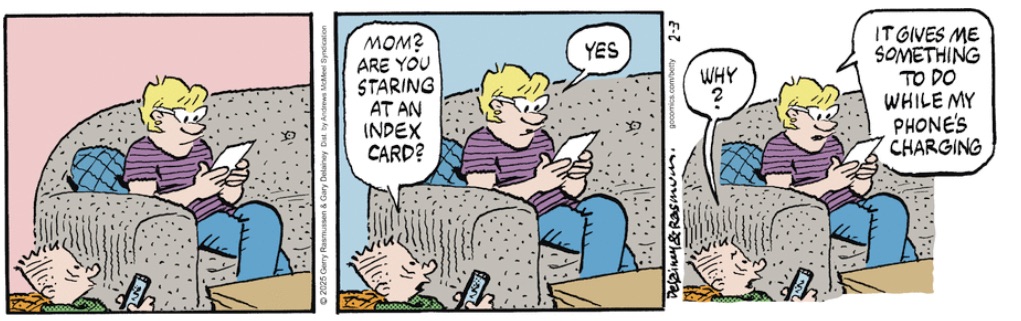
I like that this article focuses on a few key issues: talk to children about smartphone use. I like less that this is pushed onto parents, many of whom experienced the PED at the same time as their children and have also fallen a bit into not knowing good netiquette strategies to avoid some pitfalls – as recently highlighted by Gary Delainey and Gerry Rasmussen in their Betty comic strip: https://www.gocomics.com/betty/2025/02/06
As the report indicates: bans alone are not enough. While the focus suggests reducing how much time students spent on their phones… I recall similar discussions around tv (and previously around radio… and before that the OG distraction tablet: books) and looking at studies ‘average viewing time’ and laughing because I knew my own hourly consumption was well above the average and many consumed more hours than I did… what helped: education about the medium. If only there were a place where youth could come and practice and learn about e/affective strategies to use the most powerful tool to disrupt education… as I have always differentiated screen time: consuming or creating content – there is a neurological difference.
Unless of course, a secret goal is to have students work on their creative and critical thinking skills to arrive at workarounds (fake phone turn ins are just the tip of the metaphorical iceberg). And again, when looking at anxiety and depression levels, we need to open eyes to more than the screens, but include the ‘why’ the screens are attractive (Johann Hari’s observation in Lost Connections – if there is no connection irl, then online becomes a community… <—my simplification, not his). As Hari overlooked/did not include – increased school shootings, and drills connected to this have not made in-school attendance any easier… even in our nation that does not have as strong a gun culture… the overflow is real. The climate crisis that older folks like to ignore can be super depressing if you explore that rabbit warren. And, as a student shared with me, it’s like the only conversations are about negative consequences… that gets old and disconnects me. <— I get it, and when they connected the negative consequence focus to feeling like a prison… that can get deep very quick.
There are other approaches that can be taken to help show the negatives of social media binges… and chatting with friends is important (just be mindful that there is a segment of society that struggle with this in school environments and we can’t just wish it was better… this is not new – counsellors work with many who do not have fond memories of school years). Better social skills and ‘less’ (different) bullying come with guided gradual release of responsibility – practice and supports – irl and online.
I do like the attention given to ‘rising loneliness at school’ but mainly because it is shining a light into a segment of school that many of us would prefer to not deal with, because it is challenging – to connect with the students who are disconnected while acknowledging it’s not just them… it’s the system. At least now that more are identifying as disconnected, hopefully strategies will benefit more/all.
And I do laugh at the attention to fights… I recall fights at my school being very regular – and filming them/it would’ve helped provide some evidence on who needed to get some extra support – and have definitely decreased in frequency, though they are easier to display to the public…
I think I want to take a closer look at Wales as Welsh schools tend to take a more open approach.
But I fully agree that this issue needs to better connect with parents – the tools are powerful (from helping with public transit connections to keeping track of tasks to be done and enabling work that can be done in ways previously not being able to be done easily in school – video, voice to text, infographics, connected media, interactive works) and that more support and information needs to be shared on social media’s… but not just ‘they’re bad’ – but sharing why they are so attractive and are designed to keep users engaged… I’m not saying they aren’t problematic… but they are also very powerful tools for communication. Two things can be true!
I’m glad there’s a report confirming that by banning phones in schools we haven’t addressed the problem… and if we are serious about wanting to see students (and other…) use PEDs better, then we do actually have buildings where youth gather to learn – we just need to be brave and share our inside thoughts while using the tools… much as many of us do when modelling reading… and writing… and mathing. Do as we do, not as we say/hope/wish…
 Technolandy
Leave a comment