Day 114 (of 2024/25) teen disengagement. Not new, so why so much attention now?
The Teen-Disengagement Crisis — The Atlantic
Teen disengagement is not new. I know we like to ‘blame the screens’ but I still remember zoning out of many classes playing such amazing games as ‘close my eyes and open them when the clock hand is at the “x” number. Interesting that we haven’t banned clocks in classrooms… more seriously has been the long (for me at least) looks at disengagement in those middle school years that is well over a decade in formal discussion…
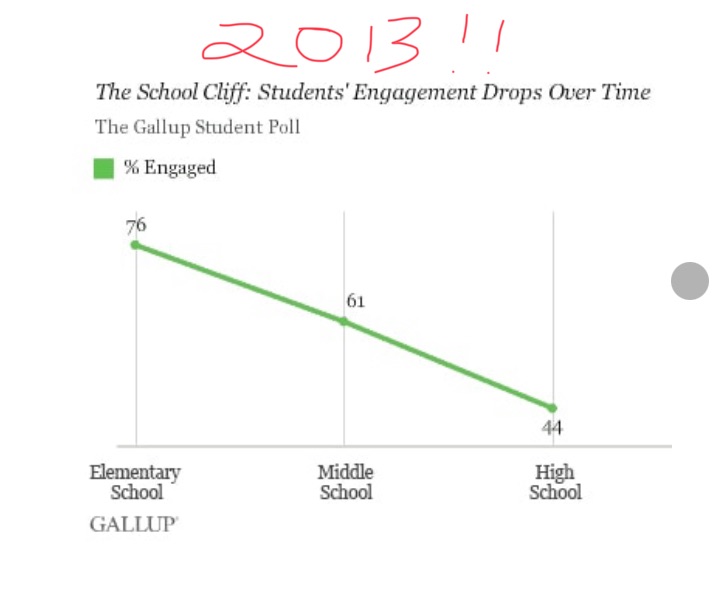
Even more formally, Gallup polls indicate that 25% to 54% of Gen Z K-12 students are lacking engaging school experiences; Engagement is particularly low among non-college-bound students; Students are most excited to learn when teachers make it interesting
https://news.gallup.com/poll/648896/schools-struggle-engage-gen-students.aspx
so this leads into the pondering/need for alignment of what ‘engagement’ means… especially as I fully agree with the sentiment of the article (and related book): KIDS ARE WIRED TO WANT TO LEARN. And the article confirms the earlier graph that in grade 3 (third grade is american talk) 74% say they love school – by grade 10, it is 26% though 65%of parents with grade ten students think their kids love it. So over the past 12 years, the number of primary students enjoying school is still the same, but the high school group has fallen even more out of love.
I do love that social media folks are already calling out the part that points out topics of rote memorization
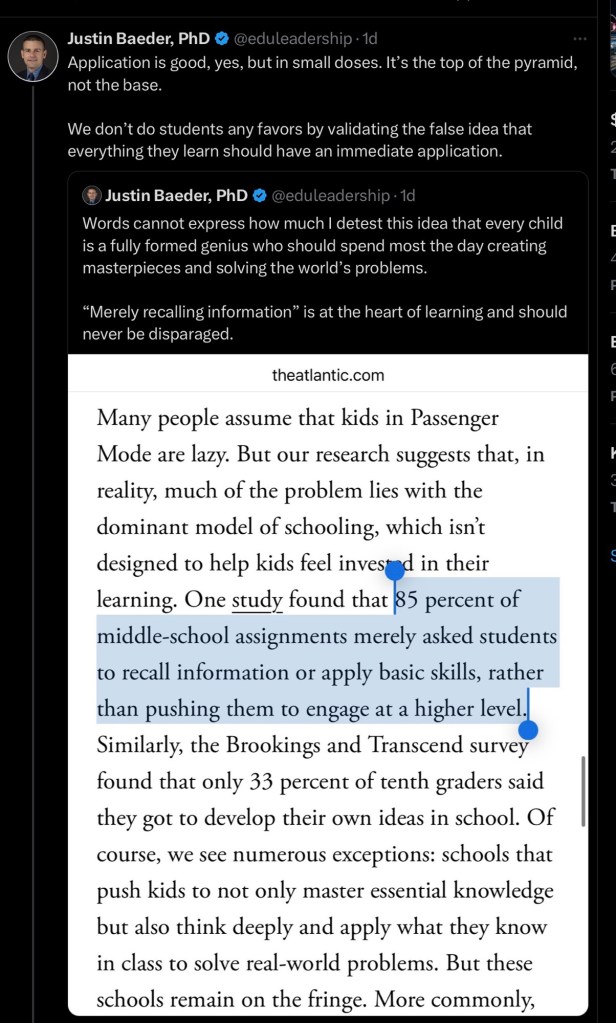

So of course, I love that this article (and even the social media folks) need to consider what it is that being “an educated person” actually means. Who defines/determines ‘success’?
Many of us were (from the article) ‘quiet quitters’ at various points of our learning journeys – for me it was definitely connected to when the focus was on memorize/regurgitate – know how a formula is applied, not why it does what it do. But that was also when the promise was ‘go to school, get a good job’ (which was a lie even then as more than a couple left school to work full time… even though they were in jobs that don’t exist now – the temptation (and need) to generate funds for the family is compelling compared to staying in a building that keeps you in a zone of frustration.
Bias: love love love the reference to Vygotsky – we really need to stay focused on that zone of proximal development and remember to push when we think its right (even if we mis-time it ~ as I have a time or two ~ when the students are aware of the ‘why’, it is always understood).
And with the ‘value of broad memorization’ being devalued over the decades with the availability of every answer (but a couple which imo only exasperates anxiety and neurodivergence because the couple of unanswerables are not meant to be thought about for too long [death and infinity] but neurodivergent brains only have those to ponder on ) being in two clicks away, the focus on school needs to be reflective of this. Where we can see value in what we want/need to memorize and not have it decided for us. I am a fan of rote memorization because it makes some tasks easier (spelling and ‘basic’ math) and some more interesting (name the infield of the 1977 mariners) even if not always relevant for everyone to try out for Jeopardy!
Quiet Quitters and ‘kids in Passenger Mode’ are not lazy – I will echo this knowing that many brains are working very hard – just not on stuff that will win them a Governor Generals Award. But just asking to repeat information or fill in a worksheet doesn’t lead to ongoing relevant: challenge activity – at next staff meeting hand out a worksheet for staff to complete in the limited time available. Heck, even give it a multiple choice section that in the last five minutes they can give to a neighbour to mark and go over the answers!
I even had a student who perennially did horribly in math class… until we had a standardized test that made him do something more complex (applying two skills/strategies) and his brain lit up – it wasn’t bored doing single step equations and he found math was suddenly fun! But that was an accident as we hadn’t thought of providing more complex math to him because of how he ‘struggled’ with the more straight forward questions that were supposed to prepare him for more complex computations. And, I fear from my own kids experiences, the focus on completing tasks (and the related punishment that any 0 can provide to destroy any chance of overall success – check out the work of Ken O’Connor that has made me agree that a ‘zero’ should never be used and why I am so happy our province has promoted ‘not averaging’ scores (even in high school) as a way to de-emphasize how ‘mean’ (pun attended) some forms of averaging can be.
So, a redesign of schools? Will Richardson has been pushing this for over a decade. And like whole language was taught to me, this does not mean ‘keep something out’ but ‘add it in’. Rote memorization has its point – but, my main example, not every student needs to memorize the name of all 206 bones. Some do. Okay, one does…
And at home, we (as parents) tend to default to that key strategy: nagging. Even though we know homework does not really help (and for the most part widens the gap of those students with work responsibilities form those allowed to meander in their scholastic reflections) but sometimes it matters (you gotta get into calculus in order to get calculus). But an MRI nicely proved that criticism fired up emotional pathways and decreased cognitive networks – so you get upset and shut down.
A solution: for parents – encourage teens to develop more autnomy (ooh, I feel a scholastic connection to PBL – project based learning!!) and give up control. I think it’s okay when students ‘mess up’ – either to learn that: an 87% vs stressfully studying all night to get a 92% can be a better feeling; that not paying enough attention means a redo is appropriate; or that what a student/family sees as ‘success’ can be different than what outsiders may wish. With a reminder that ‘giving up control’ doesn’t mean not supporting – reminders of supplies… hints to ‘read the book’… asking ‘what can you do…’ and unlike Allen Iverson, knowing that sometimes practice does matter.
I like the term ‘passenger mode’ – this links nicely with my fight against “just tell me what I need to know” <— which definitely comes from a memorization/test focused education model to ‘shifting into drive’ in order to understand why the learning can be helpful and benefit the learner. Again, kids want to learn – and they can – and they want to practice… I see rigor all around me, just not always focused on the curriculum. But it is there.
As Justin accidentally shared… ‘society determines what an educated person is’ – perhaps it is time for a Will Richardson inspired reshape of this ‘experiment of school’ (article I found in my dads journal from the 1970s) to better reflect the world around us – better incorporate some key challenges like climate changes, identity, screen use (not just banning them), and the global interconnectivity that is helping us note that the skills needed for the 22nd century learner will already be different than the skills (evolved as competencies) that have been noted as needed (still in some areas) for the 21st century learner.
Looking forward to reading “The Disengaged Teen” by Jenny Anderson and Rebecca Winthrop that this article was based on!
 Technolandy
Leave a comment