Day 138 (of 2024/25) Pro-D Day!
Autistic – Affirming Communication Supports
Great share about how we ‘used to’ do things that we now do better… and the value of listening to our inside voice about what feels righter and wronger… neuro knowledge keeps getting deeper (and we have to be comfortable trying something new…)
Used to… withhold items; direct teach with sentence strips; focus on labelling and requesting; token board for participate; drilled responses to questions; etc
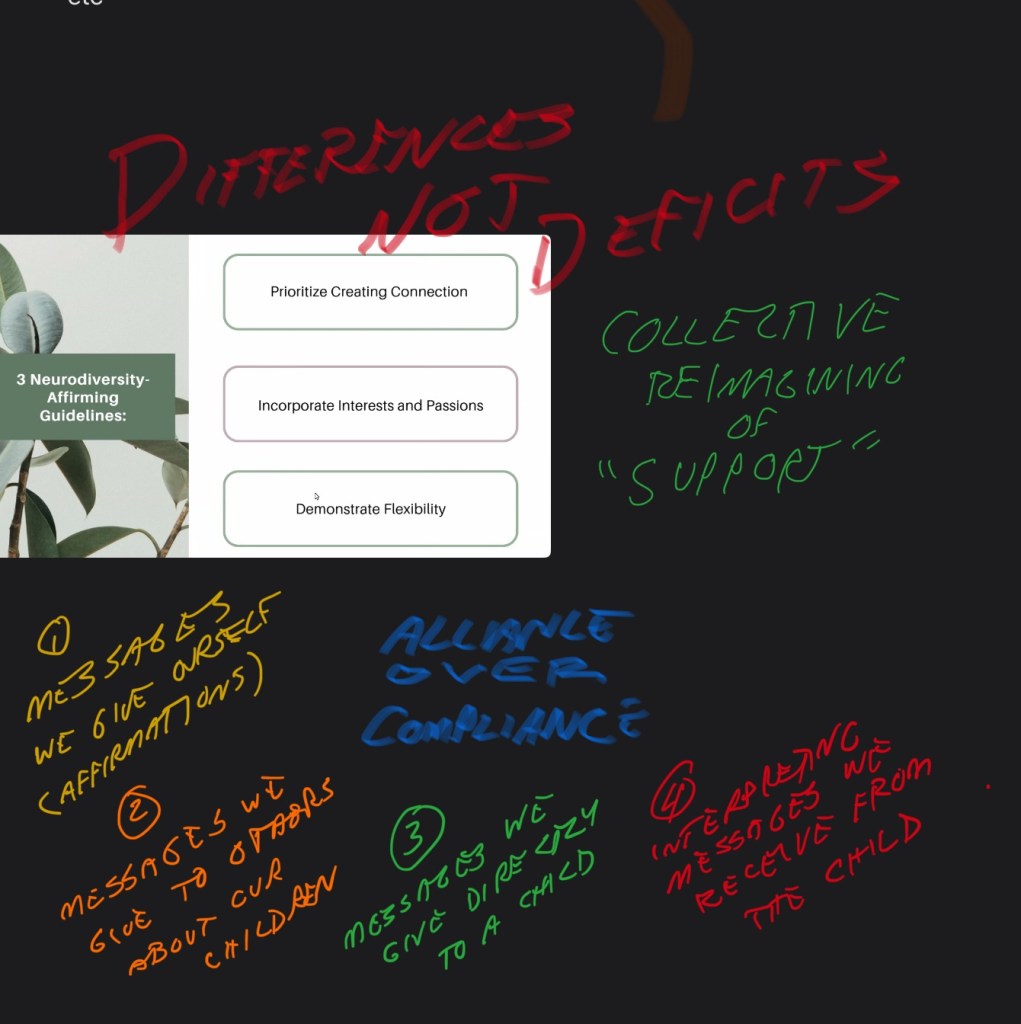
Collective shift in collective view of acceptance (can’t ignore the parallel that has been going on with sogi/lgbtq2ia+
Value of holistic views of child
Still barriers to systemic change…
Communication x=x spoken words – more of a ‘dance of communication’; and more communication = messages (tones, language, drawing, words, but communication is not in our control! – so we want to create communication rich environments!
Secret Sauce to support… ‘you’ – the shift starts with ‘you’ not the students… the truth is: how we show up to support is a DIRECT reflection of how we view autistic kids.
Typical Lenses to situations:
Eg autistic child trying to get inside classroom
Lens: The Fixer
Interpretation: this is a problem… they need to stay with a group)
Response: Compliance based strategies
Lens: The Explorer
Interpretation: there may be a sensory issue happening
Response: alliance-based strategies
Giving us a hard time? OR Having a hard time?
Willfully disobedient? OR Something deeper at play?
Manipulative OR Needs support/leadership/compassion
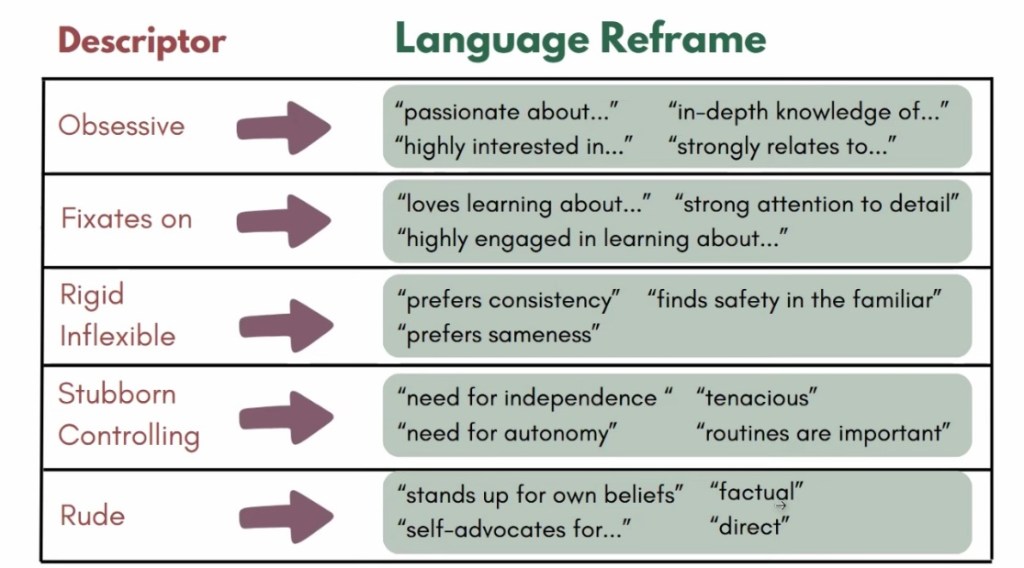
Language is a powerful tool – easy to unintentionally cause harm and shame – how we communicate is so important
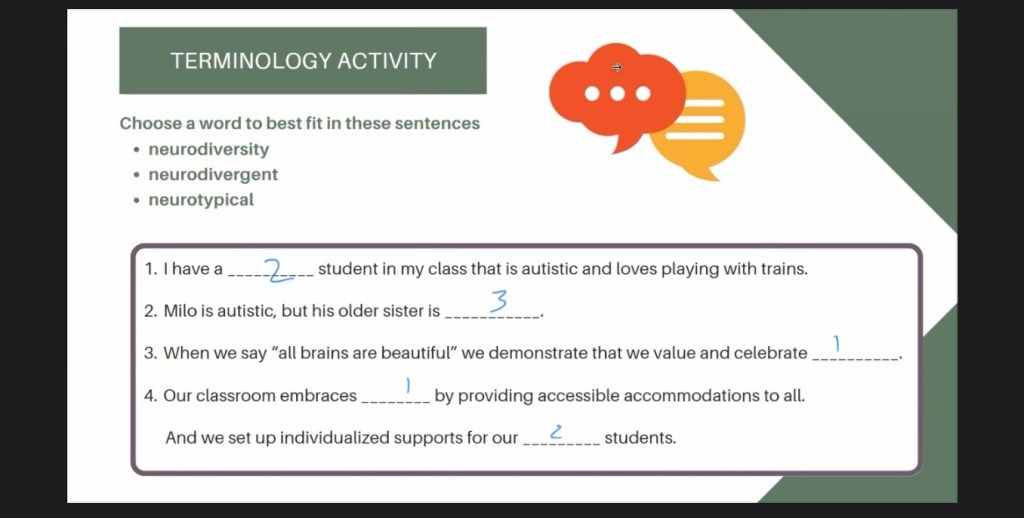
eg Neuro Divergence and Neuro Diversity are different…
Neurodiversity: an umbrella term that acknowledges that neurological (brain) diversity exists. All human minds differ from one another and there are infinite variations. References a group of people.
Neurodivergent: refers to an individual
Neurotypical: the majority brain working
Identify first language (person with autism vs autistic person) autism is a natural part of the way their brain works, and thus an integral part of their identity.
Henry is autistic (rather than H is on the autism spectrum… H has ASD)
There is an autistic child i support (rather than a child with ASD… on the spectrum)
Affirming Language matters
- how we talk about autistic kids
- Model the way we ant autistic kids to be viewed and treated
- Describe using a strengths based lens
- YOU are in the position to EMPOWER
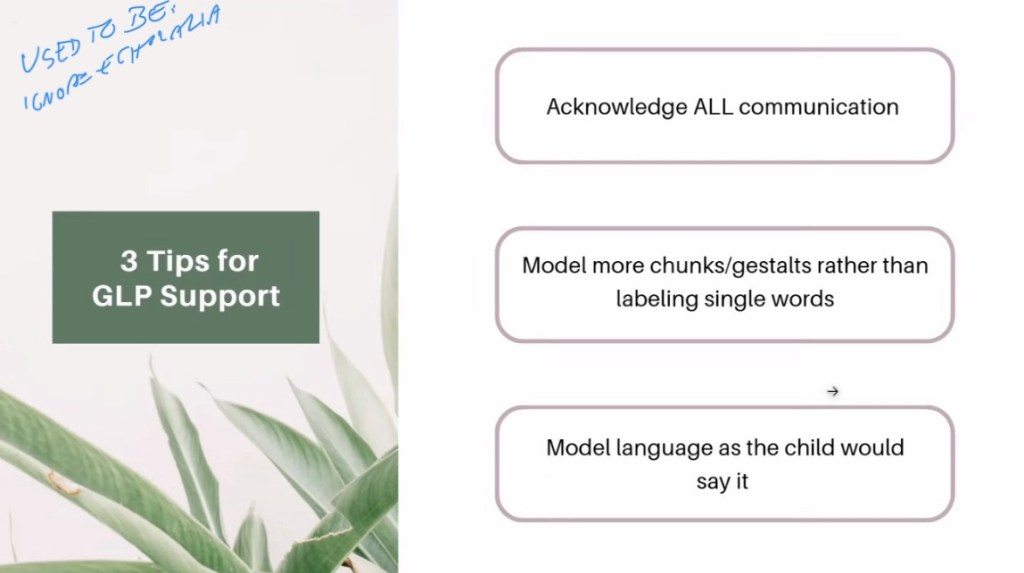
A unique way to develop and process language … Gestalt Language Processing
Two ways to develop language
Car — Go Car — Go Car Fast
Gestalt
Here comes the car/Lets get a snack —> here comes the snack/lets get the car — car go fast/ go car. Car fast — Look! My car go so fast
But more of a continuum. Possibility of ‘dual processor’ some analytic and some gestalt…
When Gestalt? Student is:
- very into national
- Often singing or highly engaged in listening to songs
- Answering questions is difficult
- Use long strings of language that sounds liek gibberish
- Repeats lines from movies, shows, or books
- repeats everyday conversational language
Immediate Echolalia – repeat back chunks or parts of chunks directly after hearing it:
Do you want a snack? Want a snack? (Processing time… committing to memory…)
That’s so heavy. That’s so heavy….
Delayed Echolalia – repeating something heard previously from a movie/show/song or from conversational language
Chase is on the case! Henry gotta go potty?? <— how it was modelled to share ‘they’ (someone) needs to use the bathroom
Echolalia is communication – it is meaningful – it requires detective work
Eg: Twinkle twinkle little star = somethings wrong
Thanks for watching! = I’m finished with this! Or time for you to go….
Where’s mommy pig? = somethings missing
Sunscreen, sunscreen, where are you? – happy to be outside!
What else do we need to consider in order for a child to access language and communication?
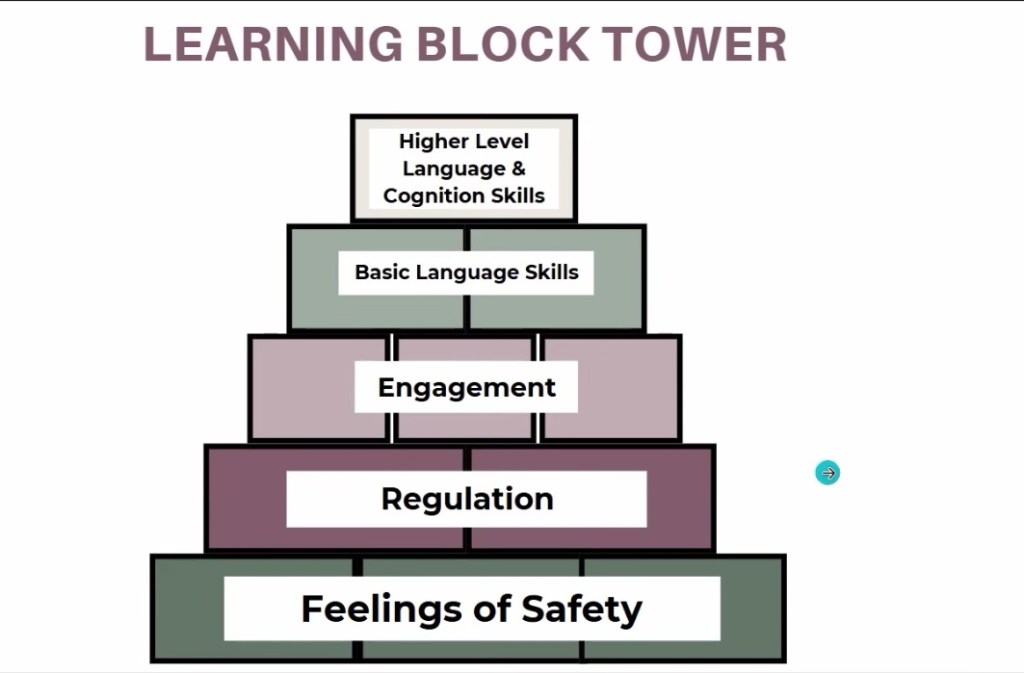
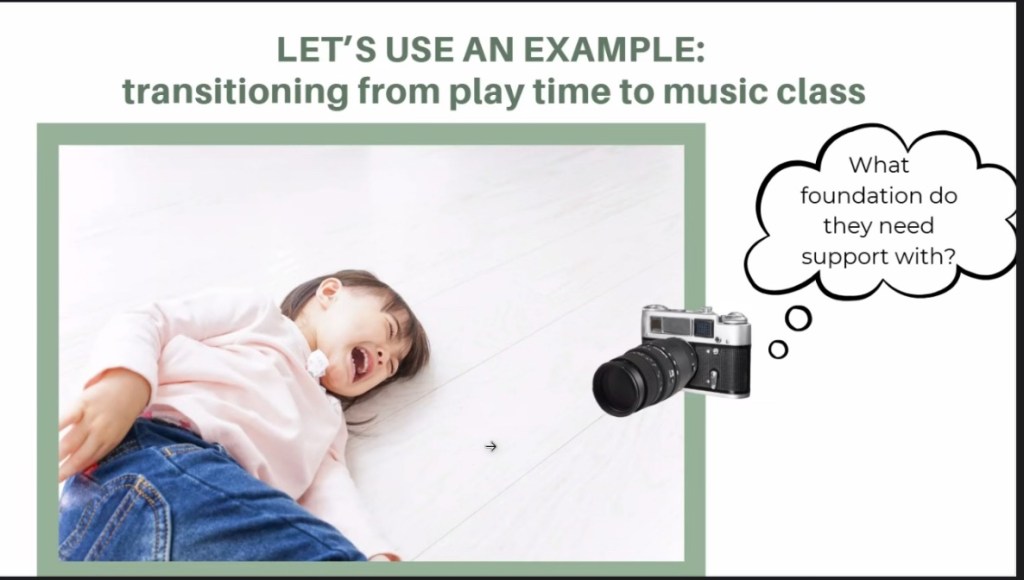
- Does this child feel safe (not ‘are they safe’)
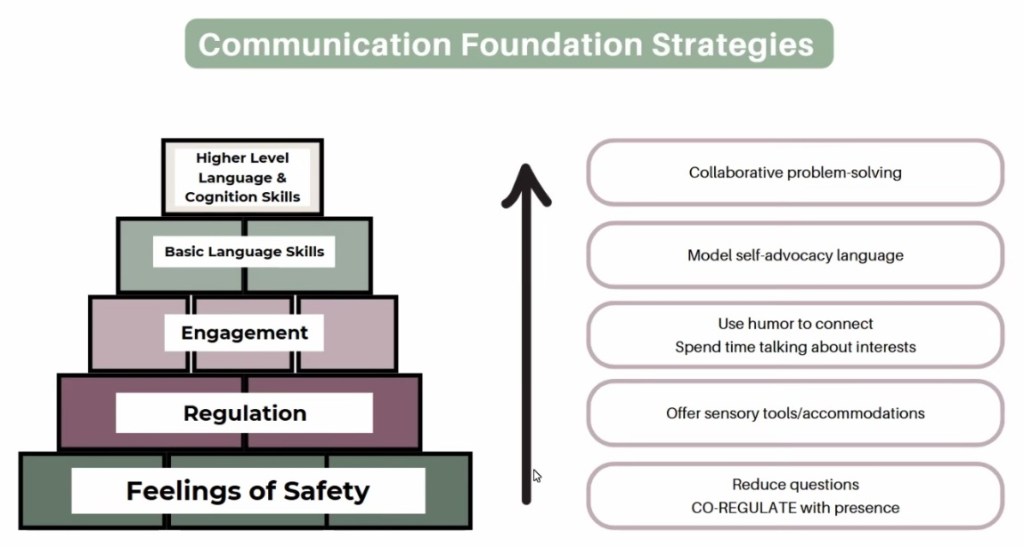
Review:
- the importance of shifting perspectives and co-creating the right conditions to nourish our little wild seeds
- Choosing our lending to help shape our responses toward supportin autistic kids
- The power of language and simple language shifts we can use
- Understanding more about natural autistic communication styles
- Use the ‘explorer lens’ to get more curious
AHA Moment for me: the value of language choice
**************
Three tricks and shares
Mine based on a theme <— don’t interrupt things too fast:
Mindset of ‘embrace the chaos’ – also known as ‘trust the process’
Power of ‘wait time’ (inside count to 100) – and the wonder of ‘body doubling’ online!
Modelling – reading/writing/mathing ‘recreationally’ not as part of a ‘lesson’
***************
Most Likely To Succeed re-watch
Scary to have it highlight the trend of fewer and fewer jobs (10 years ago – only magnified by recent advancements in AI and robotics… the environment of school is less and less reflective of “the real world”.
Watson did well at jeopardy a decade ago and large language models are infinitely better today. The job of “knowing things” has been shifting every year… it’s fun re-viewing the opening with the knowledge of chatgpts et al influence on our world.
So, what do we do when electronics do physical and mental power better than humans…there ain’t no jobs coming if manufacturing “moves” back to North America…
and school rooms are quaint. I know some still love rows et al, but my last classroom had a much more fungi inspired seating arrangement that worked really well…
Good review of the Prussian experiment of “learning” based on age – ability – and subject area.
School schedules based on adult efficiency, not learning (thanks Sir Ken!) and as much as many connect the school system to resembling factories… I’ll poke and say prisons likewise reflect… factories? Schools? Vice versa?
The power of drawing (rather than text reading & rereading)
Still love this segue into High Tech High and Project Based Learning!
Great activity: define boring
Tony Wagner identified then that content is ubiquitous- now we have tools that will even better sort that for an individual learner. What skills do you need to acquire and work with knowledge… as needed…?
If the goal is to pass a test, has that made “knowledge” is disposable? What you got vs what you have… (knew vs know) how good is retention of what was “learned”?
How vulnerable is the North American middle class to AI/robotics replacing their jobs..,?
While a couple teachers in the movie say that in PBL, finishing is so important… over the years I have had an appreciation for “incomplete” works/exemplars…
And the example of an authentic deadline still resonates with me…
Shifts to what do you know and do… not a focus on what you got wrong/didn’t learn.
You’re gonna do it better next time because of what went wrong this time.
3Ps:
Planning Process Presentation
Hmmms
Online Socratic seminar? A way to get Philosophy credit…? Live option and asynchronous – same for a “film class” or AI supported?
Design thinking showcase
End of year exhibition of learning? Online and in-person? Build off the “here is your square on the bulletin board – show yourself off”
Ooh – does the adult dogwood give a more purposeful, relevant graduation path (vs the “educated citizen” as described/envisioned by a bunch of old people last millennium?) 5 courses is the minimum… university pathway for 18+ year olds hmmm more like gardening than engineering (thanks again Sir Ken)
 Technolandy
Leave a comment