Day 167 (of 2024/25) Creating Emotionally Safe Schools, #booktok share by @thierck and Jane Bluestein
Happy to have read and be able to recommend the latest book by Tom Hierck and Jane Bluestein – a great dive into the elements that change the environment and climate of schools around the broad concepts of ‘safe schools’. This book will make a great PLC Book Study or an individual pro-d journey to take a dive into the more-complex-than-a-set-of-rules approach to being safe at school…
Starting with a reflection when Dr Bluestein was first invited to write a book about improving the emotional climate in schools… led to what seems like a fairly simple question: What affects emotional safety in schools?
So many things… (my bias – there is a big complaint about personal screens, but I’m really glad that guns and violence is revisited in the early pages of this book – we can’t pretend that the US celebrations of the 2nd amendment are not scary and brutal on school climate)
I also love the authors collaboration is not going to be “he says/she says” but “we says”!
Part 1: Dimensions of a Very Big Picture
Love the metaphor of an impressionist painting – focusing on a bunch of dots, or see how they blend to get the complete image? Likewise when sensational incidents occur and our focus narrows a little too much… Yes, violence at schools.. but also giving an oral presentation (as Jerry Seinfeld reflected – the fear of public speaking is so great that if you attend a funeral, most people would rather being in the casket than giving the obituary! Also playground dynamics, or the end of the school day (had a principal give regular reminders, that I continue to echo, that summer and winter break et al, aren’t looked forward to by many in our population… and when a students strengths are not able to be highlighted through a standardized test… ugh. Safety is relative! Emotions even more so! Especially when ‘traditions’ at school are followed because they always have been…
Gotta blend the ‘whole’ with the ‘individual’. Hey, if it was easy, anybody could come into a school and be a teacher!
Balancing the range of fears – from the fear of expressions of second amendment rights to worries of being called on to give an oral presentation to the classroom… the range of actual and potential challenges to safety are real and feel the same… even if many of us wish they didn’t.
Chapter 1: What safety Is:
It’s not just about guns… but the broad consideration of safe schools is one where students are safe from violence, exposure to weapons and threats, theft, bullying and harassment, the sale or use of illegal substances on school grounds, and other emergencies… but I like that the book asks us to consider the broader:
Physical safety (as above)
Social and Emotional Safety (where voice and choice is valued)
Identity safety (social identity is an asset rather than a barrier)
Academic Safety (failure is part of the learning process)
And two components to also ponder: structure and autonomy – and aspect of Behavioural Safety.
I like that the authors (unlike another certain book targeting anxiety…) are willing to address climate in schools with the correlation/causation(?) of school shooting violence in US schools with more than 387000 students experiencing gun violence at school since Columbine (a key marker for us older educators).
Good reminder that: In Maslows hierarchy of human needs, ‘safety’ is #2…
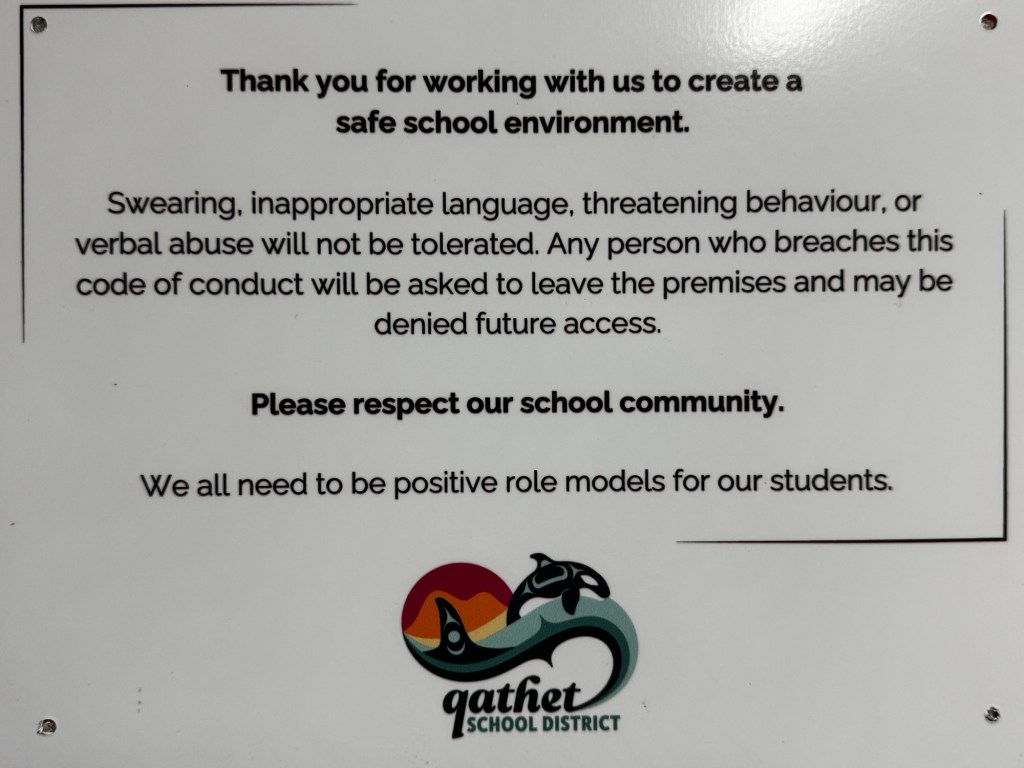
Some great reflection questions for educators to consider when considering how students and adults are treated in school… good timing since our district just had signs posted in our buildings….
Love the dives into:
- resilience and grit (I like grit, but I don’t like how mis-used it frequently is…)
- SEL (Social Emotional Learning) to help offset daily/seasonal challenges
- The importance of belonging
- Recognition
- Understanding
- Freedom(s) ~ including the inclusion challenge: we welcome everyone, even those that wish certain other groups were not here… as long as they keep those thoughts to themselves (and ideally learn why they are great members of the broader community!)
And that school safety is for students and adults
Chapter 2: The heart of the matter – feelings and school
Great parable about the challenge vs wish of “leave your feelings at the door”… such separation and compartmentalizations is neither easy nor healthy!
Great section on a Positive School Inventory. Do a local scan for feedback and comments – the goal for a positive school climate is to hear/see 3 positives for every 1 negative… This chapter in itself could be a great ‘back to school activity’ for staff!
Chapter 3: Safety – it’s a brain thing
Like the Daniel Goldman reference to “we have two minds, one that thinks and one that feels”
Great refresher on the elements of the brain, and the most common fight/flight/freeze characteristics. Tom’s writing is one of the best examples I can use when I do refer to aspects of our education practice needing to be different ‘now’ because what we know about neurology ‘now’ is so much different than ‘then’ (used to be the last millennium… but really every ten years…)
Q-Tip philosophy: Quit Taking It Personally
Chapter 4: Learning and the Brain – building new neural networks
Well, let’s get thinking about the brain – and the importance of building neural pathways. Sorry AI (iverson, not the intelligence) but practice matters (though AIs point about practice not needing to be the same for all remains true).
Great transition to all the sensory inputs beyond ‘the words on the page’ that the brain is processing. And connections to the emotional energy in the classroom… one of my favourite shares on this was a behaviourist who was mindfully late and a tad panicked as she entered her training session…set off the adults so much that they needed an early break to walk/talk/coffee/calm down before moving on with the agenda…
Memory with emotions matter ❤️great reminders of the oddities of memory! And the roles of fear & stress on learning…
Chapter 5: Body and Mind – working together for growth
Good reminder that few can actually ‘sit still and listen’ – and fidgets help… I believe we are biased to approve the fidgets that worked for us and dislike other/new ones…
“You cannot sit still and pay attention,” says Mary Sue Williams. “You can do one or the other, but you can’t do both.”
Great chapter looking at factors to help me with one of my own landy-isms: sometimes you need a distraction in order to focus.
Chapter 6: Where children are coming from – stress and adaptation
Great examples of trust – an observation a counsellor once made to me when we were talking about ‘the marshmallow test’ and how while the report was on rigor… it was also about trust (except that was not a test parameter)
Good review of Fight, Flight, Freeze (though I’d also mention ‘Fawn’ – the ‘cozying up’ to avoid being targeted)
Love the look at some of the ‘family roles’ that appear at school: family hero; invisible child; troublemaker; mascot… (probably also why I have thought about the value of having male/female admin leaders… though I have changed this gender bias in recent years)
Important section to read is: Monsters in the Closet —> parallels to my annual reminder that ‘not everyone is looking forward to summer vacation’…
“Safety” is neither a universal expectation ‘at school’ and not always intuitive…!
Chapter 7: Over the Edge – a world of violence
Glad the authors (as I mentioned earlier, unlike a certain other author looking at youth anxiety…) point out the rise in school violence as impacting the sense of safety at school… but they also highlight the impact of family violence being tough cycles to break…. Kids do what they see and people tend to seek what is familiar. And yes, people always like to assign blame… heavy metal… D&D… video games… movies… all are influences… media is the message… but they are not viruses… always more going on…
Active shooter drills and metal detectors… influcence the climate of the school but haven’t been shown to have much of an influence to eliminate violence; knowing your students continues to be the most influential and effective method..
Chapter 8: Brave New World; the changing role of the school
I like the look at the evolution of the industrial influences on the origin of this thing called school (start at a certain time… do what you’re told… repetitious operations… break when/where told… long break for farming duties.. I (Ian) worry we are encountering our ‘Netflix’ moment… and yes, education might just be ‘blockbuster’
Increasing concerns: educators dealing (more) with cognitive issues/management; dealing with SEL; … essentially being more like homes… and supports for mental health supports continues to fight a tension of those who want more and those who see it as a negative (cuz its expensive)
Hurt people hurt people; healed people heal people…
Oi – the focus on testing … and more testing… if it was so good/helpful, why are there not more ongoing standardized tests for adults (oops – some governments might like this idea…)
Big fan of Tom’s perspective in this chapter… so many better ways we can assess learning on a more personalized/differentiated level…
Tests? The lazy way to look at ‘effectiveness of teaching/learning’
Thought there might be a bit more of a look at personal screens (now at the cheap/plentiful range many of us could only wish for a decade or so ago) and social media connectivities/communities…
Chapter 9: All are welcome here – the need for community
Here is another of my own Landy-isms: Inclusion is challenging because we welcome everyone – even those that wish that certain others were not being welcomed – as long as those thoughts remain ‘inside thoughts’ and are aware that they are likely to change…
So… what is ‘community’… fun school discussion topic following Redfin this chapter! Friends… those you are friendly with… those you trust… those you don’t… Can a teacher be all things to all learners? Or the right fit for some at the right time? Not knowing which interaction is the important one…?
In our province one of the most important (In my opinion) survey questions is whether or not the student has two or more adults they trust (and who encourage them <— not the exact wording). Gotta know someone in the school likes to know you..
Great list for teachers and principals to consider when building a broader supportive community – including turning mistakes into learning opportunities.. not matter what the age!
Love the power of advocacy… I can’t help but wonder if there is also a (book in draft) power of nemesis… do you need to give the middle finger to an adult along the learning journey and prove them wrong?? But for now – the value of what humans desire: affection, attention, appreciation, approval, acceptance, acknowledgment, affirmation, admiration, adoration, and affiliation!
Chapter 10 – Snags in the Tapestry
Fully agree with the writers that when you walk into any school, you get a vibe… and just like you go nose-blind to smells at home… not everything about schools is great… patterns do need to change… and I like the analogy of looking at the school as a dysfunctional family… to seek what might be able to be done better… Good considerations: 1) Impression management (the staff room). 2) Oversimplification. 3) Reactivity. 4) Scarcity thinking (Dr Shelley Moore would likely add to this with “people as the only resources for IEPs). 5) Negativity. 6) Productive vs Process (final outcomes the only focus).
Shifting to positivity by focusing on new patterns that are constructive and productive… (1) Authenticity; 2) complexity and paradox; 3) proactivity; 4) abundance thinking; 5) positivity; 6) process orientation
This would be a fun focus for a pro-d day! Look at patterns and which ones are sabotaging progress… which can change… which can end… what new ones you want to start….!
Chapter 11: More Welcome than other – discrimination and belonging
Always love a reference to Twilight Zone – and Eye of the Beholder is a profound episode! While we celebrate diversity, we also need to scan our own implicit biases… not even I’m immune… especially as we misremember how we (and others) were in the good old days (that weren’t)… and the important soft stat that is a factor in students potential success: does your teacher like you?
Great timing in a sense as I once again brought up the observation that our state (province) religion can be inconvenient… when told that we don’t have a state religion, I did point out how prominent school closures on Good Friday and Easter monday stood out coming up after Passover…
How often do outliers have to ‘fit into’ the dominant cultures within school… and of course, how do the adults act/react to challenges to these… this is a complicated chapter to tackle and get into.. especially with many political stands being taken to ostracize and criticize som of the people in our neighbourhoods… Bias happens. And a neat perspective to unpack… “everyone wants to be part of something, even if that thing is bad, unhealthy, or harmful…”
Gender Wars continue… and my girls have all reported sexism through their education careers… whether comments or outright treatment, and often not even meant to be mean by the adults… but definitely disconnected them from the adult ‘mentor’…
Another great chapter to disseminate as a staff! Great perspectives to bring to students to also discuss about feelings and realities…
Chapter 12: How does your garden grow? More diversity, more discrimination
Great animal allegory to talk about how standards and expectations may vary… and… another fun one to explore – taking a survey of the standards and the bias threat may exist within them… the discrimination… the mix of expectations vs readiness based on year of birth…
Labels are limiting.
Happy to see the notes on ‘retention’ – the negatives have long been noted long enough that this should be used very rarely… and, as I have said: when everyone is convinced that a repeated year will lead to greater individual success for the learner with no other interventions or supports. I know social media likes to point out the ‘fail forward’ frustrations, but that is a systemic stigma that needs to be dealt with differently. Rant done (for now)
Gotta be intentional when dealing with discriminatory practices – especially the ones that hide in plain sight (thanks to systemic/organizational practices).
Part II – the Toolbox
Great introductory metaphor about the tools you use when you have them…
Chapter 13: Academic Safety – learning and success
The challenges… even just having students think and share and show vulnerability… fear of being made fun of…
How important ‘frame of references’ can be… and readiness… and changing a ‘fear of failure’ mindset/culture.
Love the segue into feedback and assessment (huge fan of descriptive feedback loops!). Love ‘descriptive assessments’ to add to my list!
Let’s maintain and grow the curiosity that so many start with in kindergarten…!
Chapter 14: Emotional Safety – personal and character development
The value of having a ‘someone’ in whom you can confide… heck, I even engage the ‘cone of silence’ (Get Smart) in my office to allow some overshares/vents/etc to release some steam in order to sort out what’s actually important to talk about… as I say, you can never get in trouble with what you say in the office (for students and for adults)
Culture trumps programs
School values vs family values
We are more than cognitive beings
There is importance in belonging – especially when they feel unnoticed… seemingly anonymous – doesn’t matter what the adult view is, that is the lived reality we need to acknowledge and reach out and have… “people listening”.
Gotta watch for changes in baselines (normal behaviours)
Great section looking at ways to support children * especially children in crisis… another great discussion chapter!
I continue to miss our provinces grade four module: Friends For Life – great introduction to CBT and coping skills…
Chapter 15 – Social Safety – Belonging and interpersonal competence
Yay! Marshmallow study makes its appearance… and its narrow focus on ‘impulse control’ (I have my other biases…)
EQ matters, and aligns with two key (continued) problems highlighted in teacher social media: impulsivity and aggression.
When frightened, riskier behaviours are taken (carrying weapons to school) nice note that the most dangerous weapons continue to be: words…
With two of the biggest areas of concern (as reinforced through teachers on teacher social media) being: impulsivity and aggression. Love the emphasis on emotional intelligence (EQ) and the reminder that the most dangerous weapons brought to school remains: words.
Survival skills that may be effective at home and outside… are often liabilities in school (especially those that involve violence) shifting between rude & inappropriate behaviours to bullying… (targeted and repeated imbalances of power) safety is compromised when the behaviour excludes, embarrasses, frightens or threatens.
Gotta show what we want to see – that includes teaching and modelling how to cooperate, take turns, asking before taking, sharing, and get attention in constructive ways… the younger the better, admittedly… and also how to disengage from the energy and influence of ‘the crowd’; identify peers who play the way you want to; use of humour; the power of using calming thoughts… and some great tips in the book for improving the school social culture…!
Remember that kids do what they see – and the brains capacity for classification and inference making is powerful… even when making sense of prejudices and stereotypes… and learning from the broader culture (aka systemic discrimination and perpetuation).
❤️ the emphasis of the Teacher as Model – I continue to push teachers to do more modelling of key ‘things’ – reading for pleasure (let Microsoft Reader do the reading assessments), mathing (show that math is more than worksheet/repeated questions), writing (model vulnerability), social media/screen use (where else are they going to learn/see good use?) as well as the adults reactions – turning a blind eye? Shrugging off violence as a rite of passage? Builds character? Punishing those who report threats or seek sanctuary? How to manage power struggles… how they will get treated by seeing how ‘you’ treat others…
Chapter 16: Behavioural Safety – Discipline and Cooperation
Be aware that many common discipline policies and practices can actually exacerbate the problem.
Another good chapter to dissect with staff!
Don’t take kindness for weakness… but also don’t rely on black-and-white thinking. Seek win-win wherever you can!
What supports are in place to help young people change the way they acted… or the threat of more punishment meant to be enough?
“Decades of research have shown that physical force doesn’t help students manage difficult feelings or choose positive behaviours” paediatrician Nathaniel Beers. WHO also agrees showing that corporal punishment actually increases behavioural problems…
Spoilers of good ideas to dig into:
- Establish win-win power structures
- Deglamorize obedience
- Respect students need for dignity
- Make the connection
- Make success possible for everyone
- Eliminate double standards
- Set and maintain clear boundaries
- Think of consequences as positive (sidebar: recently suspended a student to our study hall to help give them a reason to get out of the house and into our online programs physical building)
- Follow through
- Depersonalize conflicts
- Focus on the positive
Chapter 17: Physical Safety – the student body
I still remember the discomfort of most sitting in desks for so long…
Hydration matters (but/so don’t remove bathroom privileges)
Movement (aerobic) activities matter – and removing it early takes away a healthy habit… more recess & more free play! (Model how of course!)
Sleep matters (but so many things get in the way – especially the early starts… why so early? Cuz daycare needs usually… imagine a softer start being part of the day… a chance to eat… meander… play… read…
Environment matters – AC can help filter the air (and give a refreshing cool breeze); lighting matters (I much prefer fluorescent lights off); sound matters (with tinnitus, there is no such thing as a ‘quiet space’ – and background sounds actually help with regulation! Musical hint – the melodious tones of Michael McDonald (and Yacht Rock) work wonders… though I’m still trying to find an old reading I had that encouraged two forms of music to work with math learning – baroque (not a surprise) and disco – a definite surprise… but the beats per minute that seems to activate parts of the brain are eerily similar between the two genres… not to mention how noice cancelling tools can also help those that need ‘more quiet’ than others… I’ve loved having classrooms and schools with varying volume spaces…!
Food and diet are always of concern, and I will point out that while the provinces and federal government are tossing money at the food problem in Canada (noting that almost no schools are set up with cafeteria spaces/equipment) our nation remains the lone G7 nation without a food program for students (except for PEI) – with ongoing debates about ‘targeted or universal’ (only universal seems to work, but its $$$) and the type of food to be provided (I’ve heard: ‘one step up from gruel’ – which gets my blood boiling – almost as much as: ‘if they’re hungry enough, they’ll eat ‘it’”)
Schema matters and we can’t assume (nor judge) when certain ‘usual markers’ are missed (as a librarian, I will continue to vent on the lack of understanding of rhyming early on and story telling in general… but I also note that I have ‘always’ had new students who were unfamiliar with the media of ‘books’ that I was introducing to them…) life experiences matter and this is where a lot of bias shows itself during assessment times… grrr – moving on…
Tactile experiences matter! I will repeat that my classroom/schools have always been a hybrid of the ‘most techy’ and the ‘most outdoorsy’… it is not an either/or
Appreciate (and wish it was in bold) that schools can no longer pretend to be a one-size-fits-all organization (this is our Netflix/blockbuster moment)
Admittedly, love the suggestions to help change the students’ level of alertness and attentiveness:
Visual field (move to different parts of the room etc)
Auditory field (varying music genres etc)
Tactile needs (fidgets and weights etc)
Movement needs (love the “Finnish model” 45 mins of work and 15 minutes free play/choice)
Mouth distractions (gum, chewlery, etc) – hydration and nourishment
And – to emphasize part of the authors share about making the resources and strategies work: not all will work at the first moment – take some time and let things play out for awhile – two weeks plus a day is a useful mindset (first week is seen as ‘play’, second week is ‘maybe this is working’, third monday is ‘well, I guess this is going to continue…. ‘)
Medical support is nice, but I have observed that often times, when conditions such as ADHD are diagnosed, doctors often suggest strategies that don’t align with ministry guidelines (eg EA time) – but the ‘labelling’ can be beneficial to help students see they are not the only ones thinking/doing the way they are. There is community and supports, not just consequences (I’ve always said, I much prefer behavioural vs organic challenges because behaviours can be conditioned and moderated… organic neurological conditions are much more complex [though fun!])
Part III – The Grownups
Can’t forget that it is also the adults who are feeling isolated, frustrated, unsupported, stifled, unsafe, undiagnosed (or late diagnosed) as well! Makes the ‘job’ challenging, and why many are more willing to leave or ‘maybe stick it out for a couple more years’…
Chapter 18 – Teacher Safety: Protecting the protectors
The shift from teachers ‘taking the first job that was available’ to (now 2025) having more choice – since 2023, the supply and demand in education vacancies has shifted… with non-teachers being hired/considered for positions… same being seen in leadership as well… and new teachers so often start in schools that already have ‘high turnover’ for work related reasons/conditions…
Great observation that as we deal with better focus on personalization, “teachers are taught what they should teach but not taught how to get children to learn”. Heck, I’ve been told that my support for a lot of curricular changes are because of my view of inclusion, but that starting educators aren’t ‘there’ quite yet… and need other experiences in order to better understand the ‘why’ – but I struggle with using models proven ineffective ‘now’ in order to help out students that will be worked with ‘later’… learn with me from my experiences… take a leap of faith…
Any ways, the time to collaborate and connect with trusted colleagues is often sought, but not always successful – it is hard to get into the ‘right mindset at the right time’ at the same time as others… and when I read that the sense of autonomy is hard to feel with scripts and schedules in some districts, I am glad that teacher autonomy continues to be one of our provinces greatest strengths (though I note, also our greatest weakness – but the positives continue to far outweigh the perceived negatives).
And the shared story around the perception of the teaching profession reminds me of another Tom Hierck book – which centers around the question of money with a dinner conversation asking a teacher “what do you make” and the best answer being… “a difference” (but still gotta pay the bills, and as often happens with female dominated industries, people are more reluctant to pay a respectful amount – or provide raises to keep up with inflation… at least now we can say this is not in every jurisdiction – some are raising the status of what it means to be an educator and putting their $ behind that belief. But not all places yet…
Great section looking at some of the things that teachers can internalize to help them feel either more positive or negative…
And love the reminder that one of my principal mentors also shared: the first week students don’t care who you are, they just want to know you care… that principal reiterated – spend September making relationships – the work will easily get caught up over the rest of the term… learning: it’s a marathon, not a sprint.
And how much trust between adults (especially principal-teacher) matter!! Gotta be able to have constructive spaces for dialogues, disagreements, debates, experimentation, etc – but this can only be productive when there is trust (and again, as a model – gotta show what we want to see…)
Adults matter – can’t forget they need support and encouragement as well!
Chapter 19: The collaborators – parents and community
Building bridges into the community can greatly benefit schools – though, as I have seen first hand, can lead to discomfort (most notably when I am promoting Indigenous or SOGI inspired learning – but also inclusion in general, when asked why I’m not expelling a specific student…)
By opening up the mindset to neighbourhoods being safe communities, it makes everyone see the power within ‘our kids’ (when worrying about how older students will treat younger ones… ‘our kids’)
And while parent involvement is highlighted, I have also experienced first hand the difficulties of many parents to trust the ‘school’ (thus me). Glad the authors confirm this sentiment. Parents can also be very challenging to work with – the number of times I’ve had to explain why I don’t emphasize cursive script (kids can still do it, but all don’t have to) and spelling lists (memorization of words not as affective as exploring spelling components – lots of time spent on -tion and -ough words!)
Love and support the reminder of the value of making positive phone calls (I can legitimately share that one parent could be heard as the phone was answered ‘what the hell did he do now’ to get my laughter and then our joint laughter as I explained how not all calls are bad ones!). Make three positive phone calls whenever you make one negative one…
Some great other trick and strategies shared (no spoilers here though – get the book)
At our online school, we work with parents a LOT – we are named ‘Partners in Education’ for the reason that we are partners with our home facilitated learners… so I love the points to remember when working with parents:
- Work towards a mutual goal
- Be respectful of time
- Don’t use jargon
- Maintain positive contacts
- Work on strategies to lead to positive outcomes
- Document
Adults gotta play nicely together too!
Epilogue: Are we almost there yet?
As much as we are a system, there are so many differences in education from region to region; country to country; school to school; classroom to classroom… still in a transition of this ‘experiment called school’ (as cited in many of my dad’s journal entries during his own exploration of doing school different(iated)… but there’s no stopping the future.
So, stay focused on your ultimate goal… as the documentary ‘waiting for superman’ highlighted: no one is coming, you are the educator the system has been waiting for! Change is ongoing and the next generations learning experiences ought to be better than previous generations (now to change classroom setups so that not everyone is facing one direction all the time!) 😇
 Technolandy
Leave a comment