Day 32 (of SOL 2025) Pedagogies of Voice – @shanesafir (and @MarloBagsik, Sawsan Jaber @sjeducate & Crystal H Watson) quick thoughts on a new “must read”
Yeah, the book just got released on July 29, but as I’m a big fan of the work and inspiration of Shane Safir (Listening Leader and Street Data are both profound influences on my pedagogy) I wanted to do a quick read and share of it to encourage other educators to put this book at the top of your ‘back to school’ reading lists! Here’s my ‘sizzle reel’ from my first read through and reasons why you may want this book! Avoid if you think we have reached peak performance at the apex of this experiment we call ‘school’:
- Editor Jennifer Gonzalez (Cultnof Pedagogy) admitting in the forward the problem of traditional interventions: …wait, that was the whole plan. Just doing more of what we’d already been doing. And how Street Data helped them change their views of what schools need to be doing.
- Reminded us that we are all, as Dr. Lisa Delpit shared on Street Data Pod, “elders-in-training” and future ancestors (Safir & Mumby, 2023b).
- “Traditional school structures have functioned like factories, ‘spirit murdering’ (Love, 2019) students, assimilating their identities, invalidating their sense of self and contributing to a growing duality, particularly for marginalized students. The limitations of traditional pedagogical practices are creating dangerous prospects for our future. Adapting our practice to cultivate student agency will bolster every learner in our community, not just those at the margins.”
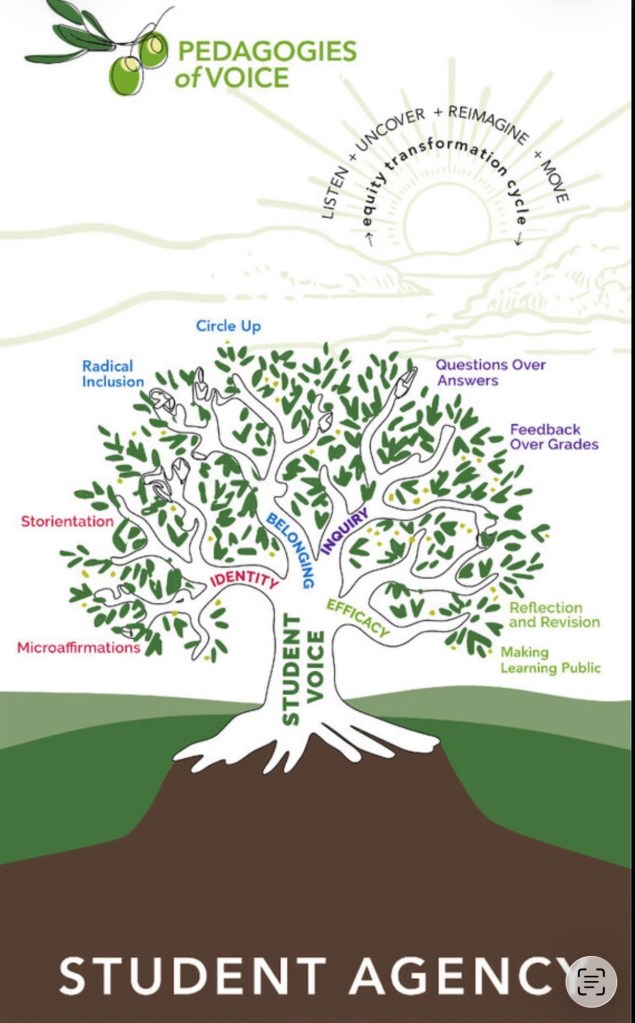
4. The learner needs to be allowed to say the following:
- Identity: My ways of being, learning, and knowing are valued here.
- Belonging: I see myself, and I am seen and loved here.
- Inquiry: I can ask questions and build knowledge in increasingly complex ways.
- Efficacy: I can make a difference around the things that matter to me.
5. ❤️ the “Awakenings: Crystals Corners” (pause & reflect) and notes sections (even if I now do my notes in… Notes…
6. Powerful reminder that students should not need “us” to declare they have a voice – they do – even if it’s nonverbal.
- It’s no wonder that scholars as wide-ranging as Michel Foucault in Discipline and Punish (1975) to Angela Davis in Are Prisons Obsolete? (2003) underscored the similarities between the characteristics of our rigid and compliance-oriented schools and those of our prisons.
- I’m liking the term “neuro-specialized”
- Language matters AND language evolves (which is part of the criticism I receive with many of my “Landy-isms”
- I reread this one a couple of times: we chide learners to “do your homework,” “get to school on time,” and “get good grades,” without giving them space to reflect on who they are, what they are experiencing in the world, and why education matters to them. No wonder so many of them are “failing” (or assimilating into dominant culture as Sawsan points out) by our broken standards! (Me again: who watches the standards determiners?)
- Ouch: Sawsan’s daughter was asked by a teacher to stand before her class and apologize for 9/11 because she is Muslim.
- Awakening hits on one of my core inquiries for the upcoming year – is success what we want or what we have been socialized to want?
- Take one breath: Let’s be candid: The historical purpose of education in America and the West has been to reinforce racial and gender hierarchies while producing a compliant and assimilated workforce in the interest of sustaining the existing structures of power. Pause and take another breath…
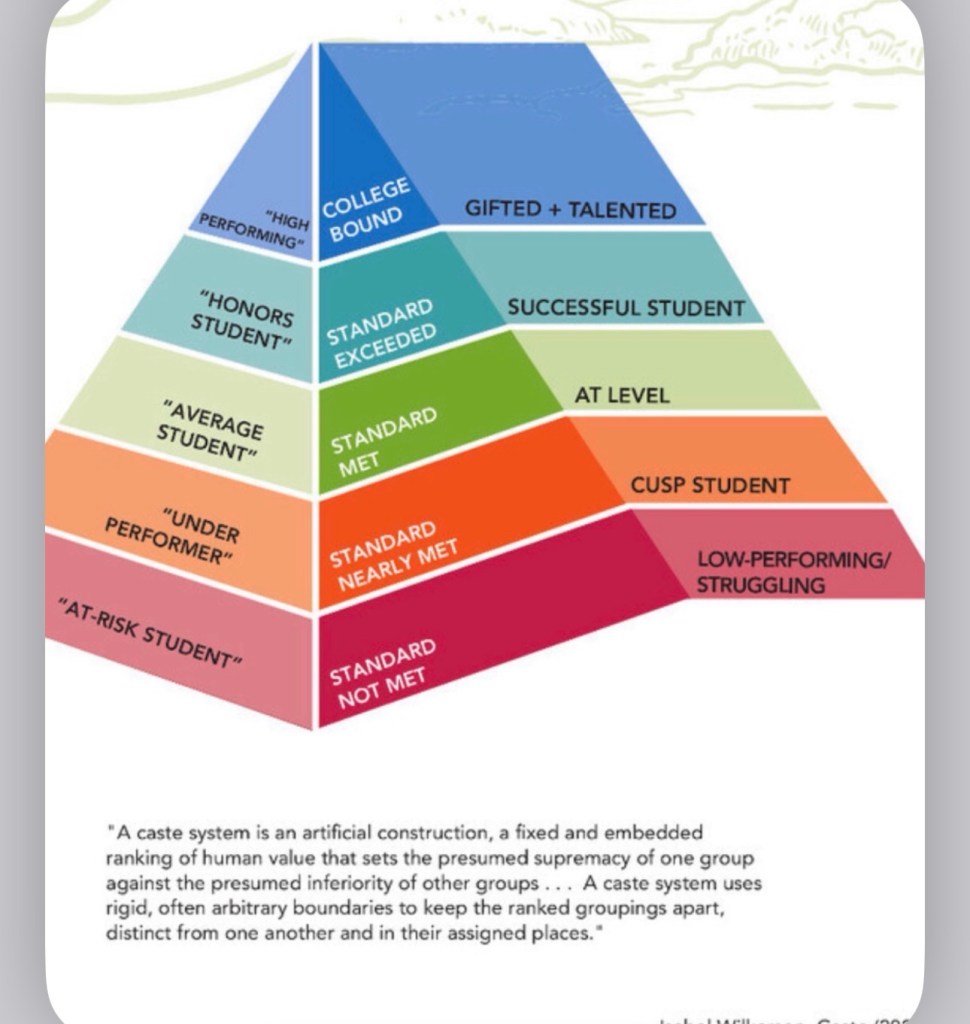
- Good reminders that while we like to think that this system of education was meant to be universal, it wasn’t… there were many tracks (word chosen mindfully) based on who you were (gender race sex) and we are trying to make a system do what it doesn’t…
- “Teachers must use their power and privilege to disrupt the status quo”
- I like “honour students in macro and micro ways” – especially at graduations where it can be awkward when one student has a list of awards and scholarships and the next three have silence – what if a slide was co created so that differentiated acknowledgments could be highlighted (even if critical of the schooling process… <— changing that would be a data mark I could support more than students silent protests by not shaking hands or not crossing the stage or not attending the celebration…)
- Powerful reminder of how looking at a school/classrooms walls you can see evidence of student voice. Making me ponder how to best do this with an online school program…
- Glad of the affirmation of oral traditions being rich and as valuable as written records
- the frontera (borderland) as a symbol for understanding inequality, oppression, and power as well as the site of deep community cultural wealth.
- “credit deficient” -oooh
- Profound reason d’être “How was she supposed to teach learners who had been so profoundly underserved by an inequitable school system? (Note: This book is a direct challenge to that sort of thinking and an invitation to find our agency amidst whatever conditions we are teaching in while still recognizing the forces of structural racism and oppression at play.)’
- Wow… Marlo & Sawsans shares on ‘when the toxins seep in’ are profound
- Spoilers of the 10 toxins (but not their ‘signature practices’ nor discourse – you need the book for more than these spoilers…)
- Teacher-as-expert
- Binary thinking
- Deficit ideology
- Power over
- Competitiveness and rugged individualism
- Containment
- Performing over learning
- One and done assessment
- Scarcity mindset
- Ego
- “bad kids.” That very idea stems from a colonial mindset aimed at excluding those who aren’t docile and compliant.
- Students will always ask for our “why”: too often the answer is ‘because I said so’ (let’s take time to unpack the ‘why’)
- Powerful 10 ways of being… to awaken the pedagogical voice (no spoilers, but another list that has me thinking “blog topics!”
- ❤️Within the classroom, we encourage translanguaging—the ability to move fluidly between languages and a pedagogical approach in which teachers support this ability (Garcia et al., 2017; see Chapter 1, page 23)—fostering opportunities for students to develop cultural and linguistic pluralism.
- Sawsan always recommends that teachers replace judgment with curiosity.
- 8 Pedagogies from the “Seed Store” – great way to plant some ideas for future use! Plant the garden slowly next to colleagues (me: become the blackberry -a delicious invasive species that is mostly welcomed…)
- Agency Domains: Identity, Belonging, Inquiry, Efficacy – good for all ages of the education community!
- “Ask me what I want to be, but not before you ask me who I want to be… and who I am…”
- How often do our children avoid school because they feel alienated from who they are? Yet panic about ‘chronic absenteeism’…
- The ‘thousand paper cuts’ that let students know they are not welcome can be as effective (as impunity and explicit) as a formal suspension/expulsion… that includes names (correctly pronounced) gender identity, sexualities, dress, communication styles, ways of moving, cultural/religious practices (why are some but not all able to get space in some schools?) kids do what they see… if they don’t see ‘themself being welcomed’…
- Find “the learning spirit” – the entity within each of us that guides our search for purpose and vision.
- Microaffirmations – the little things (glad you’re here) make a big impact… as I’ve said – some shares back to me that were profound to a student… were just a tuesday to me, and things I thought were big deals… sometimes not so much to others…
- Storientation – stories include telling… and asking – to know recognize and understand each other: activity: Letter to Mr(s) NAME: share naratives – eg pronouns… name they go by, that they missed English class because they had a sibling they had to always look after… vulnerabilities… https://qrs.ly/nng9gfj.
- Love the share on Mandela’s – first introduced to me almost two decades ago…
- Concept Books <— love this!
- Student Led Conferencing and building a capstone project!
- Inquiry – dive deep into non-traditionally taught topics = deep learning (but self-driven, not topic assigned – save that for PBL as a model for inquiry))
- Efficacy – have a positive impact on others
- Shoutout to the work of Leyton Schnellert – if you get a chance to meet/work with him… do it!
- Awaken belonging in learners. Design space… Circle up!… (do more reparative circles – not just when harm has been done).. ooh: Heartifact Cricle (Nina Finci) share something near and dear to you – note that it usually takes about two weeks to build the trust needed to get to sharing…
- Radical Inclusion: everybody means everybody. (Universal Design)
- Questions over answers – imagine this option on some of the unit tests people somehow still think are relevant…
- Oooh – on top of ‘start small’ some other prompts to launch inquiry discussions (minor spoilers): redesign your space (so much here); Debate (right vs right??); Panels/Talks, and Mulit-Modal Catlysts
- Feedback over Grades (always! Just had a chat with another educator about formative/summative – with my bias being if we do enough formative – with descriptive feedback – the summative becomes irrelevant) Only addition I might add to the types of feedback would be to include an AI collaborator…
- Provide homework for depth of understanding, but don’t use it to pad/add/influence a grade… and eliminate the 0 – so glad that the writing team seems to echo what I have blogged about (inspired by Ken O’Connor and others) several times – 0s are mathematically unfair and who says a 60(50) on a 100 point scale has to be used for the ‘pass’?
- The worries of this generation are definitely bigger as the world gets ‘smaller’ – Will Richardson’s radical thinking has shifted towards the anxiety around climate change, and I agree we need to do a lot more rethinking on this and other angst inducing big problems (because the little wonders are easily solved via google) learners need agency
- Oooh – “Making Public Learning” the fun debate between putting all the data on the office wall to look at ‘our learners’ and the need for privacy that means we should not have any public display of our students work – beyond celebration of creations in hallways… in our online school, I want to do better than a weekly-ish share of students work: such as abundance (showcasing students’ brilliance and cultural wealth), curiosity (awakening the learner’s desire to pursue knowledge) and learning as ceremony (ritualizing moments of Making Learning Public that frame the sharing of knowledge as sacred).
- What do I want students to experience.
- Reflection and Revision continues to be vital – if we believe that no piece of student work is ever “done” (like da Vinci) or if it is only important for a student to know the material until ‘the test’ and then it is fine that it’s purged from the memory banks… thus the importance of self assessment (and my recent practice of this with AI has been very affirming of it as a practice…
- Post-Assessment Reflections… great work in here!
- Love their point on “instructional minutes” – a topic I was just speaking with another educator about when we ‘compare’ traditional school “time in classroom” vs online classes where there is no set accountability for ‘how much time learning takes’ (nor is there any accountability for engagement in those factory-set instructional minutes…
- Love the inclusion of an example of food security and the ‘stigma’ of brown bag (assigned) lunches vs universal food availability
- Listen with a mindset of radical inclusion, gathering street data at the margins.. transformation always, always, begins with deep listening.
- Love the confirmation of how historically math has been a gatekeeper for many students at the margins, and happy that bc universities are finally acknowledging Math 11 History of Math as an approved course (for arts students) – my favourite math – check out the asynchronous PBL course framework: technolandy.wordpress/pbl
- Great list (no spoilers) of questions to start deep listening practices with students!
- Remember, looking for root causes is not about getting to quick fixes…
- ❤️ Reimagine with a Mindset of Creativity (a leadership skill I was once told is not commonly looked for/identified within eduction)
- Love the iceberg data collection – acknowledging both what is above the surface AND what lies beneath…
- Students know what they know – don’t make assumptions and feel free to ‘teacher’ what might otherwise wish to be assumed (card games… rhymes…)
- Equity Transformation Cycle (ETC)
- Great “microshifts” to awaken Teacher voice and agency (sorry – no spoilers, but a great list with strategies!) Really makes me want to push more for GeniusHour/20% time for adult learning)
- I kinda like the transition of PLCs to PoV Teams… microcommunities resonates well with Street Data…
- Sharing power; nuturing vulnerability…
- “Imagine a semester-long “unit” of professional learning for a school staff… imagine if that pro-d was baked into 20%/geniushour time…?!?
- Interesting juxtaposition around ‘walkthroughs/rounds’ around adult learning walks while we are encouraging it with our learners… great ‘modelling’ opportunity to show our own learnings and make that ‘public’! (Interesting that it is shared how if those walks become evaluative, teachers are often left feeling unsettled, objectivfied, or silenced – lacking a voice in their own development…
- Love the closing focused on LBL (Land Based Learning
- Pedagogies of Voice Epilogue does a great job reminding us of the journey the book is taking us (and metaphorically walking beside us) on…
- And good reminder that a lot of the opposition to ‘change’, much aligned with book challenges… comes from a small number of very loud voices… I know I’d rather be woke than sleepwalking during this era of education!
- Love the shoutout to BC’s Kevin Godden (now retired superintendent)
- As per the ‘final awakenings’
- (Identity) I am a different educator than I was when I started, but still heavily influenced and following the footsteps my father laid for me as principal 4 decades ago, before he passed way too soon… even got reinforcement that not all my “Landy ideas” are totally crazy…
- (Belonging) I belong to the qathet territory – but acknowledging more of my gypsy roots, cultivating cultures I am part of = past, present and future!
- (Inquiry) I really want to dive into aspects of “success” with a slight deviation towards comic books, video games and more librarians to help raise literacy rates
- (Efficacy) so many ideas and practices from this book are going to influence my service of awakening learner voice and agency in the 2025/26 school year – a bit more work into this reflection will inhabit my Sept 2 bookshare!)
So cool to have some affirmations of peacetimes I’ve been encouraging and still some pushes to my own practice to to help make sure that the next generation of learners experience is even better than the current/previous generations…
My second read (I will feature in Septembers First Day book share) will have me look closer at the ‘added features’ to see how this book and mindset is going to influence my systemic leadership within my school and district infrastructure.
Check out Shane Safir’s other books:
My thoughts on Listening Leader: https://technolandy.wordpress.com/2021/07/08/sol-5a-summer-of-learning-2021-listening-leadership-shaneshafir-as-referenced-in-bcpvpa-ensl-shortcourse/
My thoughts on Street Data: https://technolandy.wordpress.com/2022/10/03/day-18-of-2022-23-streetdata-by-shanesafir-jamiladugan/
 Technolandy
Leave a comment