Day 67 (of 2024/25) maybe this reading words fad has run its course… to read or not to read…. op/ed for @theatlantic and @edutopia to consider
*disclaimer: I am an English lit major and have been a teacher- and principal-librarian. I love reading text based media. But I also know that for many, reading is joyless and a struggle… and then a couple news articles hit me thus this ponder as I also dwell on the future of education with AI and personal devices being even more commonplace in homes than books appearing on the best sellers lists…
***backstory/schema***
https://apple.news/A5B2brqXhRNCl4p6rd4-z2Q – dwelling on the refrain ‘kids can’t read anymore’ and there struggle seen in higher learning that student rigor and as novels fall out of fashion – youth are entering college without being able/having to have read a ‘full book’. More and more share that they do not read for fun. I can’t help but dwell on ‘why’ – both why they aren’t reading and why they should even be encouraged in the direction of this media fad.
Basic literacy is one thing, but when we focus on ‘structured readers that help with the science of reading’ we tend to omit the reason many of us used flashlights under covers and had novels that were above our ‘approved reading level’ – it was enjoyable. If we only read for comprehension and content… reading becomes clinical and there are other forms of media that are more … enjoyable. Saying as such to an online peer brought some blowback that things like the ‘science of reading’ (as opposed to Calkins, Whole Language, Phonics… etc – no end of reading strategies best immortalized by the Dick and Jane books…
I know the article likes to point out it coincides with smartphones, but glad that it also points out funding cuts to libraries, excessive focus on standardized testing (critical reading only) but doesn’t point out two things I am harping on: who are the reading role models that are showing that reading is fun… and a focus on the ‘skill/science’ of reading takes away any reason to read for pleasure… when it is for assessment and focused only on content. And when people make comparisons to the screens as being ‘more enticing’
Comments like ‘post literacy’ are mentioned, and may be a stretch (many books are being sold/read – though many complain because it is more in the romance department (always the best selling section of the bookstores I worked at) and not a biased vent on ‘good literature’ (I complained to my high school English teacher that we ought to read Stephen King instead of Dickens – he scoffed, but I did repeat that Dickens was a writer-for-the-masses who was valued better after he wrote… I can imagine a study doing deep into the Dark Tower series and many other of his novels) Or do we acknowledge that instead of reading texts… like the first attempts in writing using images.. memes, gifs and picture-emphasis may be the way to go… or as I am about to state – maybe we acknowledge that overall, the book fad is fading… and after 600 years, we can emphasize some of the other communication tools and strategies and not be so alphabet-focused.
https://apple.news/AZRNLHjgBTvyh2zixmlS0WQ – comments about the above article (students not reading novels) were rampant – other shares (beyond my own) talks about not assigning more than 10-15 pages of easy prose per class… a tough way to slog through a book… but as I mention, also taking into account the changing use of language… I loved Lord of the Flies in high school as a student – when I dusted it off as a teacher, I really found the language archaic… great story but the words kept getting in the way. I appreciated the share in these comments about asking students what they have/are reading… curiosity shows value – it is one reason why I try (not 100% successful) to book myself into reading for recreation in our commons area just before our ‘lunch break’ – lets me do some supervision… highlight our comic book library… shows that I am reading (not for work) and am able to meaningfully have discussions about why kids are/aren’t reading – and what they are… and an interesting insight could be that a lot of school bookrooms are full of aged books – more ‘call of the wild’ than ‘alone’ (budgets, amiright?) and the connection that readers have to the characters makes a difference… And todays era means a lot of ‘problems’ in the past wouldn’t be the crisis that they turned out to be. A quick text or gps search could resolve a lot of classic literature… the boys on ‘the island’ would be easier to locate and rescue with gps and other tracking tools knowing where we all are at all times… but I do like one professors share: I always gave them the option to read a book instead of writing a 10-page research paper. They then would have a one-on-one, hour-long discussion with me about the book they’d selected. Maybe the next time I get a chance to teach a university class, I’m going to go with this project option…
***now: a modest proposal ***
I was making an obtuse point with our superintendent as we were practicing a listening/thinking activity.. and unfortunately it’s kinda stuck with me… what if the fad/distraction that are “books” has run its course and we are better suited to put our focus and energy on the true “back to basics” communication tool and strategy: oral/aural skills.
Hear me out. The printing press was a paradigm shifting invention. It made a whole bunch of new skills needed to be known that previous generations didn’t need. It was seen and complained about as frivolous and a distraction for youth who should be doing other things. And a hope was that it could be banned and reading would only be for some… Sound familiar? Shockingly when the media started being used in teaching (some could say immersed together) then the tool was valued and had a wider impact on the growth of societies – both for bad and good…
Reading and writing have had a good run. This/these skill(s) served many important roles. A means to archive things that could not previously be archived and stored in a library… stories and knowledge. But those existed before – via verbal communications. One of my classical studies professors said the worst thing to ever happen to ancient literature is that it was written down. So now we have “a” story of Hercules. “An” odyssey. Etc. whereas in real time, stories would evolve and change depending on the storyteller and elders. Even now, those “true story of… the Iliad” as an example have many different versions – and these translations are typically based on other retellings. So what is written down remains varied from text to text… but we like to think there is one best/true version. That was never the goal in the original format of stories… they could change – at least until they were put into that constrictive format known as print media
Books were great ways to store and share stories and knowledge. Much as scrolls were before that (wonderful youtube video about the introduction of the book: https://www.youtube.com/watch?v=pQHX-SjgQvQ
Not debatable. How else could I get Will Richardsons thoughts about how Minecraft could replace most of what we hope to teach via schooling, barring him going on tour? Books cross/ed borders and were easy to transport (my moving experiences make many debate me on this thought) But times have changed. We had thousands of years of civilization without universal reading and writing and a couple hundred years where the disruptive distraction became better embraced and even created a new a goal: literacy. Reading as the mainstream form of entertainment and information.
Admittedly there is a multitude of struggles for many wannabe readers – dyslexia is interesting and the rote visual processing of letters to words is complex… as I realized when I took my finger and explored braille – imagine reading something letter by letter flashing on a page and then putting them into context… with some ‘common words’ having shortcuts, but the dogma of spelling making things extra complicated (especially for anglais) and the pressure put on anyone who could not read and write… the embarrassment of parents confessing that their young kids are better readers than they are… the lack of joy in the reading or writing process and abandoning those skills as soon as they can after (during) formal education.
Guttenburg’s printing press invented around 1440 – not the first mass publication format, but like VHS vs Betamax, the one that was most adopted… and the pressure to embrace this fad has lasted 600 years. An important 600 years as sharing writings were the fastest way to distribute stories and knowledge… until recently… why is YouTube TikTok etc so popular? Maybe because it is calling back to our earlier roots… the value and importance of talking and listening – always inherently “easier” as ‘books on tape’ have often been dismissed as a “reading strategy”- indeed, while I support the concept, I am not very good at it, probably because I often get inspired and have to jot a thought down on my notes app – but I am giving it another go with Babel! But do I under value this part that is often used as an adaption for many who struggle with texts because of my own reluctance to use this adaption of the media? Or is it not reading because it is listening and they are very(?) different skills – even if the strategies (connections * questions * visualizing * inferring * synthesis) are the same? I’m good with debate on this… at the end of the day, I think this is right vs right as long as information and stories are shared synthesized and transformed into something else (reflection, new content etc)
My son once asked me: “if schools are preparing us for the future, where is the class on/about YouTube” – we recently re-talked about this – and expanded it – I once took it as a means of careers – if we teach drama, writing et al, why not how to produce content for online markets as well… but we both reflected on how much actual learning we (especially he) has done via visual/oral means, and while many of us have supplemented our lessons with a classic Bill Nye video… why not explore more (for surface level understanding – passions will dive much deeper via visual, oral, and text sources of information) …
And then I think about the modelling around youth – how many books and readers do young learners see? Where do they see them? Are they new and current? Are the spines broken with many folded pages? Are they at home? Are there stacks on teachers desks?
How much do we focus and push towards science of reading (note the lowercase letters – I am not talking explicitly about ‘that program’) that emphasizes important skills like phonics and blends as well as comprehension, but tend to use books that are programmed as “engaging” rather than naturally drawing in readers… there is a reason why EB White only had time to write three books (very deliberately created to engage and model what readers can expect to experience) but also why the best selling books are the romance section (though not honoured always as “good” reading) and are ‘page-turners’… I love books that make me have to read ‘one more chapter’ before I go to sleep (or do another chore I am avoiding)
When adults are also listening to podcasts and watching social media videos…and not modelling the PDFs, .epub and .mobi formats of entertainment, why would anyone think everyone still needs to go to the paper tablets? Especially as I reflect to a key strategy I use as I read a book out loud and share my inside brain functions ; modelling my connecting, questioning, visualizing, inferring, synthesizing, making transformations! I do these with oral story sharing and having students make their first attempts using their aural skills prior to using their visual recognition skills. Hmmm. We emphasized the value and importance of read alouds in class (though I always made the text available to scan along with)… maybe we über emphasize this… I mean, hearing the Wild Robot led many in my class that year to find the book and read/own it themselves…
But Science vs all others … is it the visual of a reading crisis? https://www.theatlantic.com/magazine/archive/2024/12/lucy-calkins-child-literacy-teaching-methodology/680394/?taid=6734a3cc3254dc00011292b6&utm_campaign=the-atlantic&utm_content=true-anthem&utm_medium=social&utm_source=twitter what’s the point? I like Lucy Calkins work – the depth and breadth of her writing program shook up how I did both teaching, assessing as well as modelling. But it’s kind of like the ‘whole language’ vs ‘phonics’ arguments that reached their zenith when I was doing my teacher training – my whole language guru pointed out that phonics and phonological awareness and direct instruction are of course part of ‘whole’ language – whole means using a wide variety of tools and strategies because not all of us acquire reading skills the same way… as I see one of our grade 2 students walk by with a novel that came from our intermediate class library… but the focus on Lucy (and ‘balanced literacy’) became the ‘wrong’ way to teach and ’Science of Reading’ was ‘the’ right way… My bias: there are flaws in every ‘one’ strategy or program. Even Lucy shares that she expects teachers to teach phonics, despite critics claiming her program doesn’t give it value… 5 year olds need phonics. Quote I loved from this article: I was reminded again and again that education is both a mass phenomenon and a deeply personal one.
But… what if we dive deeper and consider that reading isn’t needed by everyone… or even ‘many’…
Challenge 1: reflect on how often are you reading for pleasure vs information (vs at all) in your adult life?
If anything, mayhaps we should further de-emphasize the ‘value of text-only’ reading and continue to build on the recent uptake on graphic supported reading: comic books ~ admittedly re-genred as graphic novels to help build a greater maturity to help unlearn the mistaken bias that ‘comics are for kids’. With great works of literature translated into graphic form and with many original graphic-novel creations entering libraries and bookstores… why not spend more time in this style of reading? Is it about the word count, or the thinking/synthesis that is inspired?
Serendipity or not, a novel (yep, they still exist and I still love ‘em) I picked up to read while on the road had some observations about reading – no spoiler: it’s a sci-fi book from about 500 years in the future… but the topic of reading and writing comes up a couple of times:

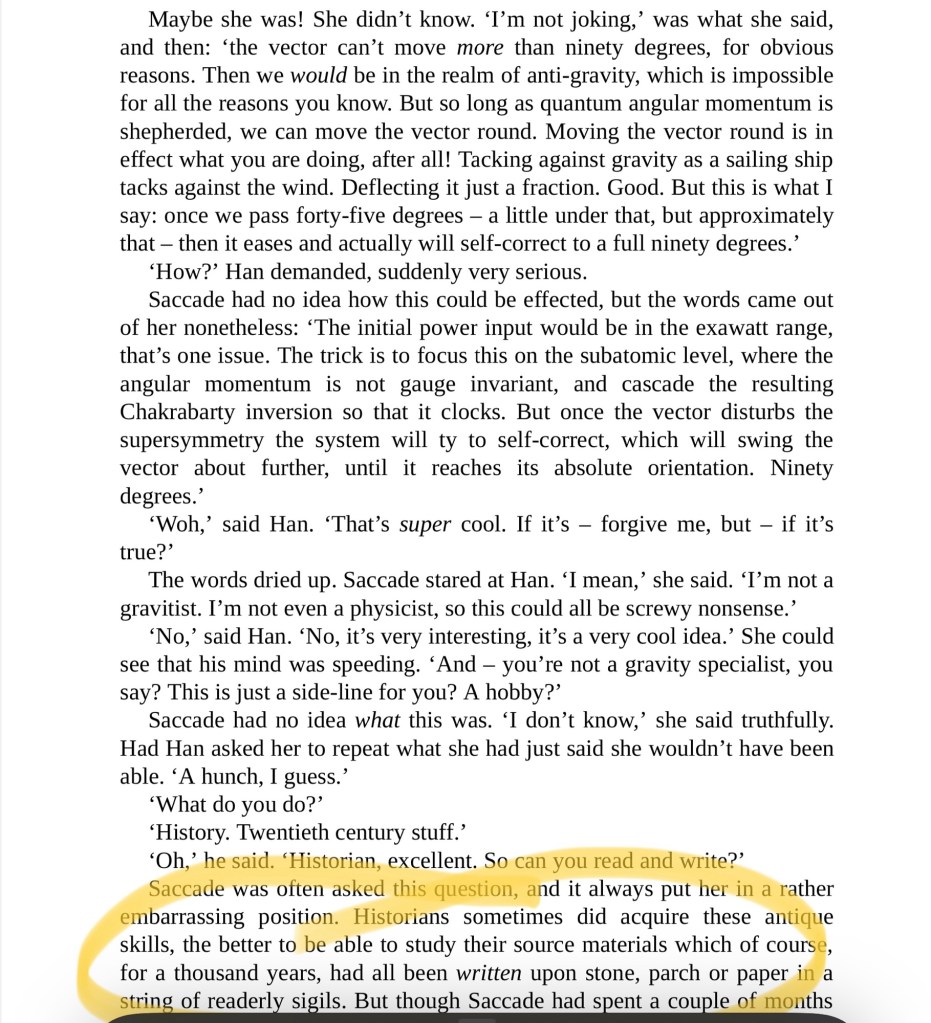
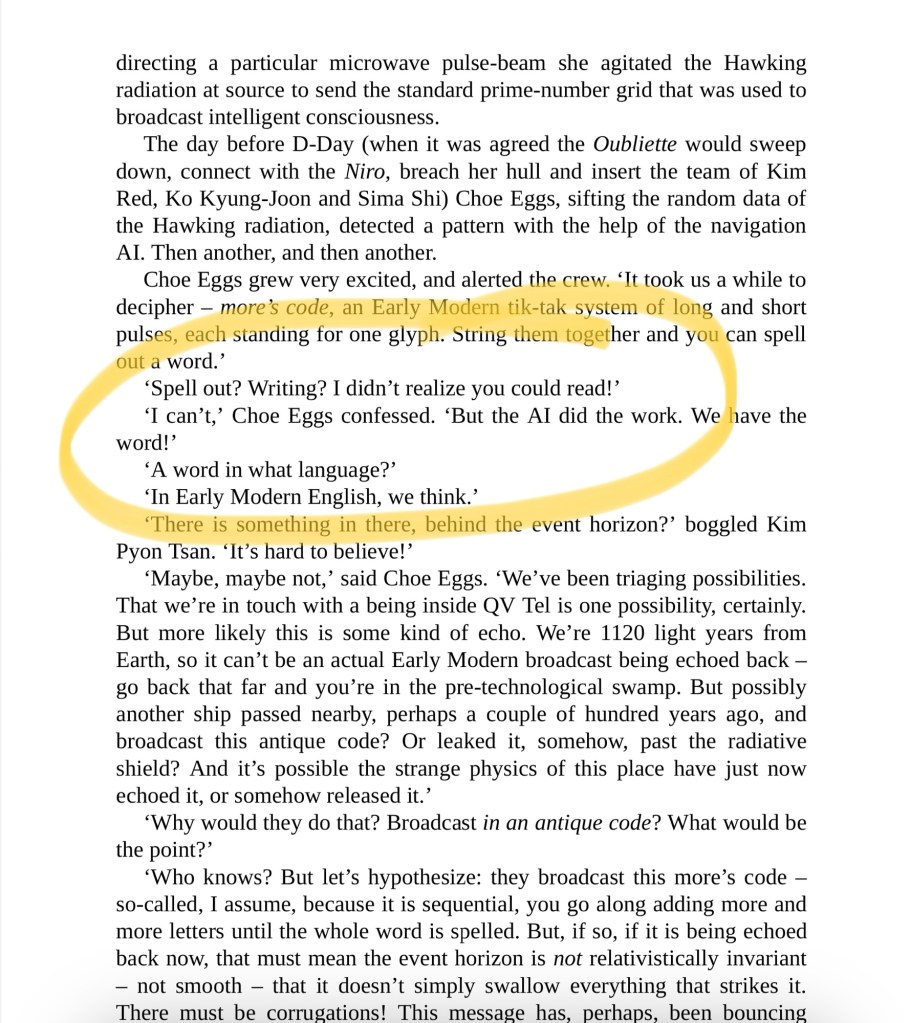
I love the mindset of ‘alphabetography’… and the reference to ‘greater tolerance for boredom’… and I love the mis-remembering/understanding that comes when the focus is on aural/oral communication – Verne… Jules? Julia? J?? He/she <— does the gender even matter when talking about historical figures? Delightful word play can take place!
And then there is the argument about how to even teach reading… Balanced Literacy vs Science of Reading vs Fonix vs Whole Language… it’s confusing even for those of us who are keeping on top of the trends… But, I do have an observation: simplified text extracts can be boring for students and adults (I’ve modelled discarding a book because neither myself nor the class seemed to be enjoying it) and many children respond more enthusiastically when discovering their own interests… even the HiLo readers I used to seek out (high interest, low vocabulary) weren’t really all that great in hindsight… but the appearance of being an older book than a preferred read was important (image matters – even in reading) But, “We’re talking about an approach that treats kids as competent, intellectual meaning makers, versus kids who just need to learn the code,” Maren Aukerman, a professor at the University of Calgary, told me. But opponents see that approach as nebulous and undirected.” <— can we learn to read by embracing a Montessori approach? I know many online who will shout ‘no’ but they are also the same ones who like the way things were when they were in school (or at least what they selectively remember) and want to trust the research unless it is newer research that shows great value in things like Project Based Learning and AFL strategies…
Challenge 2: can you spend a day without reading… have your phone read texts to you – use voice to text if you need to respond… how vital is reading and writing really <— we can make it vital, but can we ‘not’??
If we can… maybe we emphasize an initial grasp of letters —> words —> sentences —> prose & poetry, but trend more to the alternative formats – books on mp3 with supportive word texts (kinda like how so many like to watch tv with the captions ‘on’ <— love this way to reinforce some reading skills; video compositions; emogis (I just came across a podcast looking at the past and showing negative bias towards cultures that ‘did not have a systemic form of alphabet’ without the recognition of how hard symbolic representation going into these things called letters and words really is – especially over a wide geographical region… there’s a reason why more civilizations experimented with pictographic representations…
Think about how much time we could gain in schools by not emphasizing reading and writing though. The time and money spent on programs to help with penmanship and late interventions (and early intervention programs) for something that (too) many do while in the artificial school environment and then never again… had a friend whose school had reading as their only school goal – every lesson/class/activity was linked to improving reading scores… barely moved the metrics…
Can we call reading and writing for what it is: a distraction from the more time tested approach to entertainment and information – visual and oral methodologies. A fad that will continue to have its niche customers, but like calculus… maybe not where everyone needs to expand their learning? Or let’s call it closer to our thinking on cursive – good for some, not needed by most… so we’ll continue to teach it, but not panic over ‘how far behind’ someone might be… they are developing their zone of proximal development… cuz even buzzfeed is sharing observations about reading: https://apple.news/AzR_O-UwaRDqD6_4Ke5NACA and I’m wondering how it fits best in the future of this experiment we call schooling…
The same novel had another observation about reading/writing from a future reflection:
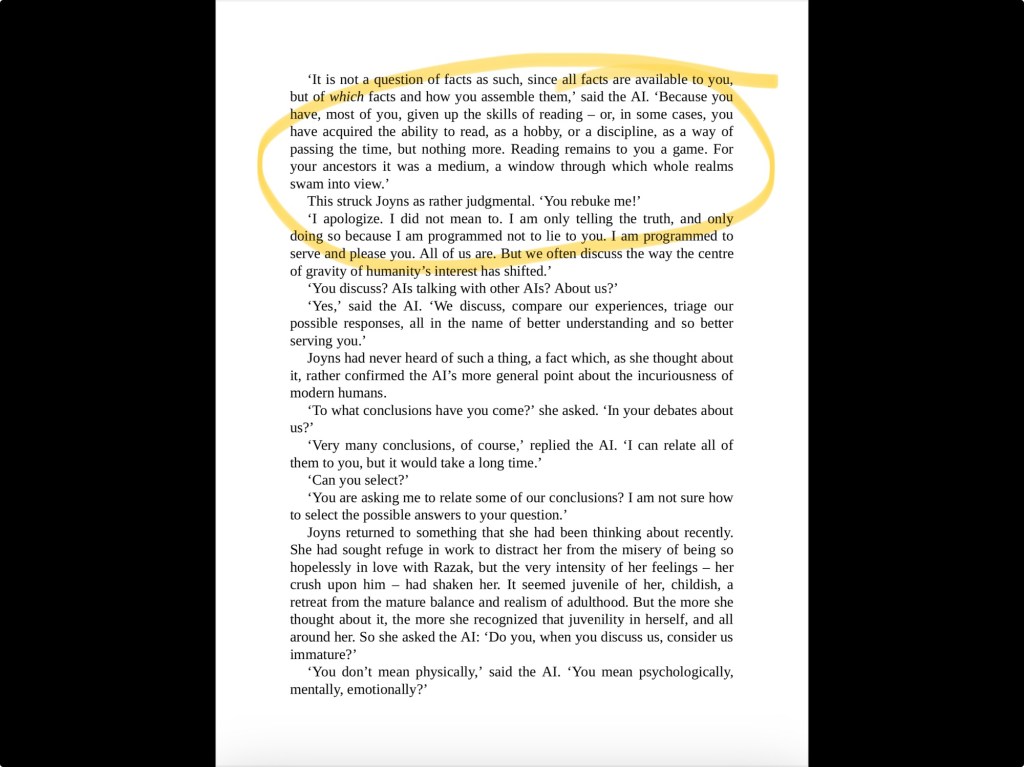
As a librarian and English major and principal (reading report cards that often emphasize in Language Arts that “text/story can be a source of creativity and joy”), I hope that my inquiry is wrong and that many choose to believe that reading and writing as a key literacy is vital and important – and choose to model more publicly this passion and show why and how these skills are important and valuable outside classrooms (even if it’s just in hallways… or in gyms – I would love a principal calling out a teacher because they are absorbed by TS Eliots Old Possum’s Book of Practical Cats rather than the PowerPoint assembly at the front of the crowd… or even Robert Munsch’s Paperbag Princess… anything to remind everyone that reading was/is/ought to be a form of rebellion and independence… a vital form of communication – of ideas and stories… a good alternative for the brain than oral/aural/visual narrations… though admitting that those are good too… but a source of education and entertainment – tools with great power, not something to be banned and ignored… ooh, that reminds me of another media tool…
 Technolandy
Leave a reply to Day 78 (of 2024/25) #oneword – Technolandy Cancel reply