Day 77 (of 2024/25) The Age of Identity – top of my ‘must read’ recommendation to educators to kick off 2025 – thank you @hargreavesbc @dennisshirley16
Serendipity – on the podcast “the rest is entertainment’ with Richard Osman and Matina Hyde shared how youth are turning to streaming services when they don’t see shows that reflect who they are – and there has always been a diversity issue on tv… but that’s a usual ‘me getting sidetracked by serendipity
This blog is in two parts – a brief summary and the ‘directors cut’ of blogs – this one got me thinking and making lots of great connections! Fabulous way to spend some bad weather days during the winter break…
AI supported summary:
As technology connects the world, education plays a crucial role in fostering collective identity. Social media reshapes belonging, making borders less relevant while amplifying inclusion and division. Education must address these complexities, shifting from standardized systems to emphasize engagement, well-being, and evolving identities.
Identity is universal, shaped by culture, relationships, and power, but schools often struggle with true inclusion, balancing diverse perspectives and addressing biases. The authors argue that schools should enhance identities, promoting equity and belonging. Universal Design for Learning (UDL) and neurodiversity frameworks offer adaptable approaches, building empathy and dismantling systemic inequities like those around gender-neutral bathrooms or Indigenous knowledge.
Hargreaves and Shipley explore how intersectionality frameworks highlight the power dynamics of marginalization, urging educators to confront systemic inequalities. Inclusion must extend beyond celebration to active equity, rejecting oppressive ideologies. Reconciliation, especially with Indigenous communities, underscores this urgency, as schools navigate identity, belonging, and diversity in an interconnected, evolving world.
Directors Cut:
Can’t help but pause as tech makes the world smaller and more interconnected at this reflection on education: “In virtually every country, education contributes to nation building by cultivating belonging among young people, through developing their sense of collective identity.”
Does the advance of social medias allow people to organize more differently – where borders may be inconveniences from a physical belonging that connects people in the asynchronous world? Can we better cultivate ourselves both in positive (sogi) and negative (flat earth) more closely virtually than in the hallways? Loving the thinking and I’m still in the preface!! Mixing the conflict of today where “identities are being oppressed and excluded everywhere simply because of where people were born, what they look like, and how people in power respond to that” with “Groups who want to protect their privileges are twisting and turning aspects of these very real forms of social exclusion into full-scale culture wars”
Also like the note that “In the Age of Achievement and Effort, (1980s to the 2010s) identity issues were officially irrelevant” – less about community and more about accountability for graduation… and in the teens we trended more to be mindful of engagement, well-being and identity in school communities. And love the notice that those of us who were working on inclusion as more than ‘just for students with special educational needs’ were ahead of the curve…
Inclusion ain’t easy as we do accept people in schools who wish others would be excluded… just making sure they know those thoughts need to stay as ‘inside voices’…
And interesting that Haidts “anxious generation” had a lot to talk about screens but did not consider: “A 2023 survey in England of students’ feelings about their safety in school found that less than half of those with “a gender identity other than male or female” or of those who were gay or bisexual felt safe compared with approximately three quarters of heterosexual students.” Just sayin’…
15 points: Identity Is…
- A universal part of modern human and educational development.
- An integral element of adolescence and growing up.
- An essential aspect of equity and inclusion.
- A process, a quest, and a struggle.
- Formed through relationships with others.
- Something to acknowledge, represent, and celebrate.
- Something that must sometimes be critiqued and challenged.
- Multiple, complicated, and intersecting.
- Presented differently to different groups and audiences.
- Sometimes fluid, but never boundless.
- Inseparable from who has the power to define it.
- Often attacked, stigmatized, and suppressed.
- Sometimes invisible, overlooked, and ignored.
- An expression of personal uniqueness.
- A resource for collective belonging.
Not spoilers – the framework why this book is a valuable read!
Chapter 1: to be or not to be?
Aka who do we think we are? Lots of sun questions including “do we really know our kids?”
Whether the majority or someone who has been oppressed or under (not) represented, “It’s hard to know how to be unless we know who we are” <— this is something I highlight to some parents, sometimes kids finally find others like themselves via media… whether it be a pronoun or a gender term… it is good to know you’re not the only one (even if you’re the only ‘you’ and that a awesome!
Identity matters… why else would some get so angry about others finding themselves in less traditional descriptions?
Love the reminder when angered “who do you think you are” is a common rage – identity matters… can I see your manager?!?
And love how the authors highlight the myriad of education philosophers who evolved the thinking of kids and learning being part of the “development of their complete identities over years of maturation and growth.” Even if many 20th century systems tended to undervalue this once strong motif of “identity” as part of schooling
Like this part that aligns with some of my own unboxing of systemic bias (eg winter vacation not subtly reflecting ‘christmas vacation’ and not any other religious observances in schools: “The content of the curriculum and how it did or didn’t mesh with young people’s cultures and identities was officially unimportant”
“So, as well as learning to know and learning to do, what else should our young people be learning? What were the missing pillars? They were existential and social. They were about learning to be and learning to live together.”
Social causes of the rising interest in identity:
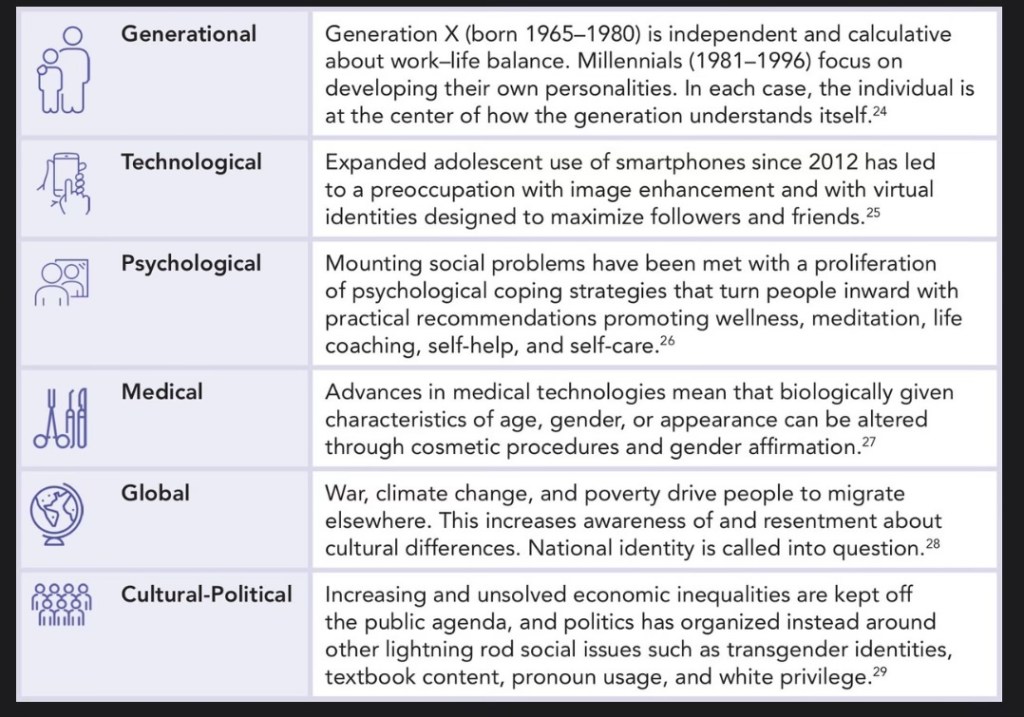
🧡inclusion is the path to equity for all students.
When I’ve had opportunities to work with university students, one of the items I propose is that education is connected with indoctrination, despite politicians, the ones literally responsible for publishing the required curriculum, saying education is separate from it…. Though I am glad the current era is about indoctrinating inclusion and equality, it doesn’t take much to see changes….
Here are some good examples: “In England, the government insists that children should learn an airbrushed version of history that downplays the negative aspects of an empire that once covered a quarter of the globe.38 After the invasion of Ukraine in 2022, Russia burned textbooks and passed new laws to inscribe Russian identity in the curriculum, while Ukraine reciprocated by removing many elements of Russian language and literature from its curriculum.39 In May 2022, a wave of protests broke out in India after a new curriculum promoted Hindu nationalism and omitted the contributions of the country’s minority Muslim population.” and Canada. And the USA are not immune from this either…
Especially when religious ideologies start bringing up sexual identities (teaching and talking about them) or even talking about bipoc authors (quick – what was the last book you read that had a strong female protagonist or an lgbtq2ia+ character not focused on their relationship with other(s)?) identity is important…
And inclusion is hard in school – as the book highlights, we (I) still welcome people who may have have strains of racism and xenophobia and religions that oppress genders (and persecute some sogi) <— still part of our community/neighbourhood! Just gotta share that I happily have my pronouns on my of office door and am really working on my ayajuthem greetings… how? Well inclusions follow this overview the authors said about working with a pro-life pro-trump teacher who fostered many children with unique needs: “In our work with him and his many colleagues, we concentrated on what we held in common that would benefit the children they taught, not on other things that divided us.”
There are always things that connect us.
And love this statement: “What is essential for some children is good for all of them.”
Genderless bathrooms (just like at home)
Indigenous ways of knowing to explore outdoors and oral stories
Collective identities have value – doesn’t mean that even I agree with everyone/everything!! it’s not about making everyone identical… and I like the disclaimer that “We must learn to work with people who are different from us as well as those who are the same”
Chapter 2: the developing self
Know thyself. From the temple of Delphi to reflections on popeye, gotta know who you are…
And three great questions from Boston College students that could be the template of our own professional and personal growth plans: 1) what give you joy? 2) are you good at it now, or could you get good at it? 3) does the world need it?
Appreciate the reminder of the importance of ‘helping young people to become more aware of their own cultural identity’ while also ‘avoid categorizing people through single markers of identity’ – know that we are all like ogres (according to shrek) we have layers, not a single stereotype ~ so respect others as you wish to be respected/valued.
Great reference to Erik Erikson’s 8 major identity transitions – the ‘terrible twos’ et all that build on Piaget’s developmental growth levels ~ and we might note, like many ‘new research in education’, they were highly controversial at first before gaining everyday acceptance… didn’t like the observation of educators with greatest effectiveness between years 8 and 23 (30 years old to mid 40s) and then vulnerable to lose commitment and effectiveness (this ties in with Hargreaves earlier work on ‘change’ – esp location when in times of change – move sooner if in more chaotic environments/times… leadership needs to make sure educators are not doing the same thing, year after year… and I like that that there was a mindful admission that gender development was not identical… and still not perfect when we consider geographical, historical, and cultural differences… and not they did not do a good job considering sogi or all cultures… growing up is not the same for everyone… again, guidelines more than actual rules.
Love the reminder that teachers “don’t always grasp that adolescence isn’t the same as when they were teenagers several decades ago” – yep, as I remind some why a ‘catalogue writing project’ may be a little out of date, and why I continue to rant that we ought to work with cell phones (that are part of teens lives) rather than ban them and make school seem even more unlike ‘real life’… same thing with the often misunderstood term ‘digital natives’ – it doesn’t mean youth automatically know how to best use digital devices, just that they are used to it being all around them – but still needing guidance of elders to know which are metaphorically healthy and poisonous choices…
Interesting to learn that the term ‘generations’ is even relatively new – from 1928 when a psychologist became interested in ‘crystallizing agents’ or defining events that were distinctive to a rising generation (and then nailed by Douglas Coupland with Generation X) – how any one cohort was influencing society as it aged and gained positions of leadership!
Silent Generation of the 1950s – economic stability post WW2
Baby Boom of the 1960s and 70s – gender equity, youth rebellion and civil rights
Generation X of the 1980s and 90s – economic unraveling
Millennials aka Generation Y – mounting social inequality, climate change and global refugee movements
Which each reinforced Socrate’s rant about ‘youth today’…
But not everyone is optimistic that each ‘next generation’ will tackle challenges – some are seeing kids growing up less rebellious, more tolerant, and access to more information and connections than at any other time in history – and social engagement is …. Changing… are students scrolling through insta… or fact checking the teacher… or digging deeper into a concept… or trying to get a definition of something shared… or jotting down notes (something I have done when I’ve been accused of texting during meetings – hmmm, projection much??)
Love: “Today’s students do not need to be harangued by older generations about their digital devices being instruments of the devil. They do not want to hear that sexual health is only about safety, and never about pleasure. Grit and sacrifice will not engage them. Endless examinations and tests may simply drive them to “escape from learning,” – Manabu Sato
And I love this timeless reminder: “A rebellious early adolescent might not be challenging your authority just for the fun of it; instead, they might be trying to establish a new identity in which prestige among peers takes precedence over everything else.”
Oooh – and juicy segue into what comes up int he book…. What about the complex and complicated identities that we sometimes feel pressed to hide…
Chapter 3: the self and others
Social Self – what imprinted on us? Not just things within us, but the processes that evolve between and among us… (oooh – symbolism within the game ‘among us’ – play it and see if you get it!
And then cultures within cultures… careers, music, drugs, etc… and, in school… group cultures to create norms to keep people in line – through implicit and explicit pressures… (not to mention race and racism… sex and sexism… gender and gender is… aka marginalization)
And in schools… cliques of all forms are created to find like-minded communities – now also expandable and borderless through the personal digital devices that it is en vogue to ban away… hmmm keeping kids away from their clique? Because our in-person experiences were good (were they always/ever?) So they must still be bully-free and full of friends who ‘get us’?
But two main cultures in school: academic and delinquescent. If schools dont offer connection to something bigger than themselves, they will seek it elsewhere (the real reason why gangs are so successful in recruiting school age members) And in contrast to Joe Clark and the movie Lean on Me… “If the school is not connected to the community, the gang will set itself against the school’. And yes, the good comes with bad as other hooligans, xenophobia et al also find community in the same ways… but again, schools focus on supporting those that are inclusive, not exclusive… so more SOGI clubs and no neo-nazi meetings…
Oooh: “identity and belonging are intertwined with power and privilege”…
And good learning through Jal Mehta and Sarah Fine: “The periphery is often more vital than the core” – I think this is the best rebuke when some wish out loud ‘if only X was out of my class, then it would be better for all the other learners…’
“We must learn to live together with people who are different from us as well as ones who are the same”.
Love the dive into imposter syndrome as being more than just ‘faking it to make/fraud it’ – but also things you may wish to keep discreet – such as gender identity… dyslexia… neat look into “identity splitting” ~ inner true selves vs conforming to false selves everyone else wants ‘you’ to be.
Social exclusion is also on front of mind – from physical conditions (right jeans… good sneakers… cool tattoo… vs constant surveillance of social media’s and potential judgement from people who may not actually even exist… the world of ‘virtual identities’… how many influencers are actually on private planes?
So glad the authors look beyond ‘screens’ when they pay attention to them (gotta be aware of other factors including poverty, economic inequity, worries about wars, fear of climate change… school shootings… ) and while many claim that ‘nothing explains the growth of anxiety among girls of all social classes, and across cultures, more than their addiction to their phones’ – I point out that the canary in the anxiety factory has been ringing since BC brought in Friends For Life = an intro to cognitive behaviour therapy (gulp, I’m afraid to do the math… 2 decades ago – and the steer away from providing this program at the same time that personal screens became more -relevant… and claims about ‘fake friends’ is just as valid in hallways as it is online – don’t pretend it isnt…! So I’m really glad the authors point out it is tempted to scapegoat screens, but it is one-sided… but when unsupported, can be frightening – the number of identity thefts; digital interactions; phishing, etc is significant – if only there were a place where youth gathered and could learn and practice effective/affective ways to use screens.
Again, glad the authors point out (after I just commented on it) that schools have always created divided selves rather than integrated/harmonious identities – i have vlogged how schools ought to be a place of personal exploration – knowing many leave home in one outfit and arrive in a different dress code daring setup… not to mention expecting key answers to closed “one right answer” questions and not emphasizing curiosity when the fear of being wrong becomes legitimately scary (not mentioned in Haidt’s book about anxiety… interesting….)
Ugh this share hurts: “demanding that children sit quietly, stay indoors, follow the curriculum, and regurgitate what they are told, schools have been actively promoting false and divided selves, far and wide.” <— we need more risky play opportunities… free play… personalized learning opportunities… stuff Dewey talked about a century ago!
Cuz nobody wants to be ‘undesirable’. A stigma. A scarlet letter… and sometimes the bullied become bullies of others… or suppressed because of governmental/colonial/institutional powers… it is really easy to become discriminatory and exclusionary. Total surveillance… limited interaction with ‘others’… enclosed and administered life… things set up for ‘good intents’ can quickly end up stripping inhabitants of dignity and identity… dehumanization doesn’t take much – imagine only being allowed outside at certain times… only being able to leave a room when a bell rings… being told what to read… getting permission to use the bathroom – or get a drink of water… monitors everywhere – in person and via camera… and people are in charge based on age. Punishments for not walking quietly… slouching when seated… not letting anyone have an excuse for absences… or not finishing work on time… hold back opinions and defer to authority – that also dictates what you can and cannot wear… is it okay if test scores improve for the people in these environments? <— delightful section to reflect on!!
Love this: “Schools should practice inclusion, not exclusion. They should develop integrated human beings, not internally divided ones. Instead of erasing young people’s identities, they should include, enhance, and elevate them, whenever they can. Schools should find ways to recognize and value diverse identities rather than putting them down or setting them against each other.”
Chapter 4: including identities
The wording I’ve been looking for: “Full inclusion is about amplifying the cultural stengths of groups and communities that have been historically neglected, stigmatized, and marginalized. Inclusion is also about honestly confronting the historical, political, and cultural forces that lead to poverty, war, racism, trauma, and the oppression of Indigenous peoples.”
And how the opposite of exclusion is not the absence of exclusion but the active presence of inclusion!
Especially as some have mindfully kept ‘inclusion’ to mean just those with disabilities within general education settings, and have struggled with it being acknowledged as being fitting for a more broad audience including refugee children who suffered the horrors of war; transgender teens; and become a principle that supports and welcomes diversity among all learners (except for permitting haters to be hateful).
But inclusion means “all learners” – including ‘that one student disrupting the learning of all others…”
Love the shoutout to Shelley Moore!! Looking at ‘being in groups of alike people should be chosen rather than enforced, and not all the time!’ The power of heterogeneous grouping (and why platooning math by ability skills never works out as people wish it would – homogeneous groupings work better on paper than in real life)
Seeing ADHD (like Andy’s in the book example) not as a deficit nor a disorder, but a neurodiverse asset! And to look at redefining some terms for the betterment of all – inclusion being for more than the SPED crowd… and UDL (Universal Design for Learning) coming from the school of Architecture! And then ensuring learning experiences are designed to fit every child; differentiated instruction to look for strategies to support diverse learners; collaboration and cooperation as strategies for each learner; and adaptive technology to enable all students to access and express their learning successfully.
I don’t like copying word for word, but this is vital: Statements to Guide Thinking Around Inclusion
- If we document how to better understand the conditions that are making successful experiences possible for students who learn differently, then we “can mobilize knowledge regarding the interventions, strategies, and activities.
- If students who learn differently are to be supported to meet their learning needs, then teachers need professional development and resources that have been developed collaboratively between special education and program departments in consideration of all learners.
- If we provide direct instruction so that individual students have an understanding of how they learn, their learning disability, and their right to accommodations, then they will be effective self-advocates from junior kindergarten to school exit.”
Upon study and reflection though – more students (85%) could identify their weaknesses, but few could identify their strengths. It is too easy to internalize and focus on the deficient orientation we in education too often use. (Glad we encourage students to take part in their competency focused IEPs…)
Great share about the work done around Canadian FNMI and the cultural genocide that led to the Truth and Reconciliation Commission – including the report and a National Day… and the journey to reconciliation isn’t going to be comfortable for many… but going to be worth it when we don’t need to keep thinking about it (and instead just be doing it).
Oooh – great section looking at the literal representation of some metaphorical work around circles – moving building and structures from less ‘boxlike/linear/closed in rooms (and shapes of desks/tables) to more open and round spaces (and desks/tables)…. Gotta move more of my work time/space into our schools commons area…)
Love the reminder of the ‘Nordic’ way of learning – 50 minutes of schooling with a few minutes of outdoor play (I sell it as 45 minutes of work, 15 of free play).
Love the share of how they address and share indigenous identity and sharing via mix of traditional activities – such as skinning, bows, walks, etc mirror the program in my current building the GIJE who are learning to reclaim traditional practices – even if skinning beaver made a few others a little uncomfortable in our courtyard… though the canoe always gets rave reviews!
Strong section on Indigenous knowledge and pedagogies!
And language… ‘we are what we speak’…. And so many languages have been suppressed and many linguistic styles continue to be marginalized. Which of course makes me wonder/worry when we use some standards for reading/writing/oral language… whose standards and who watches the standard makers?
Language; animation culturelle; identity; so many debates about protecting and ending minority language rights… standardized mandates… ugh. Glad the authors repeat my oft used “one size fits all – fits none” analogy.
The persecution of 2SLGBTQIA+ community as well… tragic history. Heck, tragic current standing with homosexuality being illegal in many countries – and sodomy remaining a criminal offense in 13 us states… shocking how many people care about who falls in love with whom… with bullying hiding in plain sight with commentary and innuendos throughout school and work places.
At least now some of my older family members have noted: I see so many (bipod lgbtq2ia+) on tv commercials now… I think it must be how they felt watching TV in the 70s and 80s… not always seeing themself – not everyone is white on tv anymore! Mindsets do change!
Just gonna note a lot of great graphics (from Ontario) highlighting how much help is available online (es for stigmatized populations) and now the tools that would best enable those supports ‘as needed’ are currently banned from those same institutes… (2024/25) correlation or coincidence along with the push for online resources for equity and inclusion of lgbtq2ia… just saying, there is a lot of backlash a bout sogi inclusion…
And a great dive into immigration… my observation is that I think that countries ‘built’ off of immigration now wanting to limit immigration without saying the ugly part out loud is kind of funny (strange, not ha-ha). Borders matter, but nations are historically arbitrary and borders are made up and change (as I read this – Trump is making statements looking at US expansions to retake the Panama Canal, purchase Greenland, and restart the Monroe Doctrine and claim all of the Canadas as one big state. We don’t reflect enough on the experiment of the ‘nation state’ nearly enough. Or maybe we do but only when skin pigmentation or religious observations fall into a unilateral line?
Newcomers have always had a tough time – and so often the trope of the ‘homeless newcomer coming to take our (benefits – houses – jobs – ???) to try to bring up som panic. Kids coming to schools… they don’t need this extra stress as they already try to mix assimilating into a new society as well as maintaining family traditions (and seeing where they may clash – as we often do with religious observances clash with civil rights and independence – especially around genders)
Great thinking and sharing in this chapter too – this book is growing on me and making me think of many others that need to read this!
Chapter 5: multiple identities
Not a fun read – unpacking the summation of Ishmael Beah’s “Memoirs of a Boy Soldier” – not every kid gets a childhood… but we can’t pretend the early experiences of kids didnt matter (It’s why i rebrand the ‘p’ in ptsd to reflect personalized traumatic stress disorder… it’s rarely people move ‘post’ reliving the trauma). We need to not do the oversimplification of identities that it is easy for teachers to do – gotta get to know all their identities!
Love the reminder that these are not fixed identities – they evolve and develop over time… dare I say it: growth identities! And this works outwards as well – we cant reduce people to one aspect of their identity – there is no ‘master status’ for individuals!
Love the look at Erving Goffman and ‘identities and impression management’ – looking at people pretending to be someone else.
Love the expansion of Shakespeare’s “all the worlds a stage…” and a reminder that life is not a one-act play, an expansion into ‘us’ playing different roles, but also having boundaries between ‘front stage’ and ‘backstage’ behaviours/identities. The connection here to students identities in schools… in community… at home(s)… online…
Great introduction to ‘transnational students’ – those who live across two+ nations and attend school in 1+ nation they call home… harder in the past when now there are tech tools that can keep families connected… but in the meantime we need to balance knowing that boundaries do matter, but it’s hard to know where some ‘belong’. But it’s not a simple binary decision. Also a good dive here into mixed heritage identity – if we think it’s in the past, we don’t have to go too far back to read in Spare how many insults and ‘concerns’ were raised over the baby of Markle and Harry possible skin colour…. As the Métis of canada know.. most likely you end up disconnected from both parental lineages… is there a middle ground? John Ralson Saul hoped the Canadian identity could be – in part because of the resilience of the Métis…
Working class also raises challenges – poverty remains one area that is harder to celebrate the way many other groups have…and gotta realize ‘class’’ is a position, not an identity. Even though we equate ‘work’ with who we are – consider how quickly you ask “what do you do?”
Neat look at how Basil Bernstein looked at how purity and power play out in school curriculum – reflecting ‘both the distribution of power and principles of social control’ and often little relevance to everyday lives. And any attempt to change subject (boundaries) leads to a worry about weakening ‘it’ and a disturbance to existing authorities and structures… this helps illuminate the fear around ideas like PBL (project based learning) that I love and use, gender neutral bathrooms (like we have in homes) decolonizing equity scans et al – especially when these many don’t just transform, but obliterate old ways. But the answer to bad boundaries is not ‘no’ boundaries, just more porous ones – the Landy mindset: -ish
Chapter 6 intersecting identities
“I defined myself in opposition to my father…” From Sarfraz Manzoor “Greetings from Bury Park” but this is a common refrain – but I love how the authors open this chapter “Good teachers know that they can’t just ask the students to conform to the school, but that they also should adapt the school to the students”
Great reflection on the movie Blinded by the Light (based on Sanfraz Manzoor, as above) and the complex identity when a youth connects with someone (in this case Springsteen) that their parents can’t understand the fascination of. And the complexity in existing with multiple identities – not irreconcilable identities.
Oooh – the ‘basic ideas about “multiple selves and identities has been moved to another level of conceptual sophistication and strategic intensity by a new academic term that has now also entered popular and political discourse: intersectionality.” <— oringated via Kimberlé Crenshaw in 1989 and explores the way power affects all human relationships.
Love the point about how sometimes ‘even some strategies intended to help… unintentionally exacerbate social marginalization’ <— a few of this talk about this a lot when talking about food programs and the need for them to be universal if in schools (currently canada is the lone g7 nation without a unified food programs, though the federal government and provincial governments are tossing money at the issue – most successful so far remains PEI).
Great section on intersectionality:
- powerlessness is a toxic human compound
- Ponder why some students are punished more often and more severely than others
- Cruel reality of critical intersectionality requires we confront educational inequalities.
- How we take on the tragic history of Canadian residential schools being a good subject to look into
- Be aware of the visible indictments of systemic oppression
- Think hard about how we classify and label students
- It is not about seeing student engagement is ‘filling the curriculum with fun and joy’… some topics are not fun to learn about – or discusss, such as the high suicide rates of LGBTQ2IA+ studetns
Constructive intersectionality – looks t the sources of marginalization and oppression not as isolated issues, but as reflections that implicate us all. Neat dive into the work and life of Drake! And can be seen with teachers who were “using constructive intersectionality when they adjusted their pedagogies to their Indigenous students’ learning disabilities by constructing climbing walls in the classroom for them to expend surplus energy on.”
I was sharing some thoughts with family during winter holidays and had one brother in law put things around sogi et al very succinctly: treat everyone with kindness… if someone is stuck on the side of the road with a blown tire, I’m stopping to help – doesn’t matter to me what bathroom they use, who they are attracted to… just gotta be nice to people. Another brother in law wondered if SOGI was just a bc thing – hasn’t made it to his school south of the border…
Good segue to learning to live together under the inclusion framework!
Intersectionality is why people can be privileged in some respects but marginalized in others… and sometimes can be surprised (especially by their ancestry and actions of their ancestors) – how does an openly gay principal and a muslim parent group get along when the former declare that inclusion of SOGI and LGBTQ2IA+ lifestyles in curriculum materials are offensive tot heir religious beliefs and family values? What happens when a World Cup is hosted and suddenly an alcohol sponsor is told they can’t do what they paid to do… and that suddenly there would be a dress code for one gender… it’s not always easy – and these are big ones – the authors share a lot of other moments of intersectionality as well! As they ponder: “How do we handle them? Is a deeply problematic part of some group or individual’s identity that is otherwise meritorious something we should overlook, or should it be regarded as a basis for vetoing or canceling all the individual or group’s other accomplishments? Or can we hold strengths and weaknesses side by side—not in balance, necessarily, but in some sort of critical relationship? When do we connect, when do we cancel, and when do we critique?”
Great writing based on the pauses for reflection I find myself taking – and way too much writing in this note reflection thingy!
Especially when people bring up that they are worried with secular curriculums not referring to religion (always an interesting area for debate – especially when discussing systemic discrimination😇) and considering some societies (eg mennonites) who are marginalized as they have not integrated into the mainstream society – their values for learning et al are different(iated)… and very gendered roles that run in conflict to larger societies moving around them… and then there is religions clash with LGBTQ2IA+ identity…
Holy books that (me, not authors) are followed in some parts, but not all… yet have great influence over large swaths of society… and conflicting as I see, as the authors state… ‘“parents who are secular often select schools that are faith-driven, stating that they find in them a sense of moral purpose that is of value for their children” I sometimes tease it out (especially if the parents are also teachers…) but don’t push too hard. But faith brings people together; forming community; and the identities that are forged in those spaces are hard to resist – and difficult to leave.
And an interesting dive into how Ontario Catholic schools (public schools btw) are making progress on LGBTQ2IA+ student identity… not all great progress admittedly).
And some great (uncomfortable) shares about how some find multicultural great until…. then it gets a little ugly – and very racist… and dehumanizing – key wording “these kinds of students”…
Intersectionality isn’t easy – more than either celebrating some cultures and traditions or criticizing or even vilifying others… engaging tensions; balancing power dynamics; oppression vs marginalization; focusing on inclusion… but not celebrating all – white supremacist groups, misogynists, homophobes and mis-truthers like Flat Earth Society are not going to be celebrated because they are different… As I have said when teaching university courses – inclusion means I welcome everyone… okay, not everyone… I won’t welcome Nazis… there is a line that even I have and I will happily be hypocritical and exclude those that wish to be exclusionary in actions and philosophies… but with empathy when possible!
Chapter 7: learning to live together
The blending of commitment and doubt… an interesting combination! How competing believes, over time – when trust forms via relationship building – can lead to sharing of doubts… an interesting retelling of Don Quixote…
Gotta share some of the 15 Reasons Why Change Often Fails (the others are why you need to get your own copy of the book!
1: It is imposed and unwanted
3: it is treated as a separate event, not a long term process
4: it does not involve the people most affected by it
5 & 6: too fast / too slow
13: lack of time during working day to implement it
15: coaching is based on compliance rather than learning.
Key parts that are why ‘successful change requires effective and widespread professional learning and development’ – but of course, in our jurisdiction… pro-d is teacher driven, which is really good… so I’m pondering if ‘change theory’ requires what we call in-service instead (but being mindful of not being ‘just a compliance activity’.
Unfortunately most anti-bias workshops work on the premise of “don’t think about elephants” (or when I do an assembly moment about snowballs… automatically an increase in reminders occurs…
Focus on: research evidence (my bias – or follow an inquiry nudge); be collaborative; embed it in workplace; and be continuous
TO work on this – the authors advance 12 principles to bring about progress for us in a world of multiple, intersecting identities! Including themes of ‘drive’ and purpose; dignity, generosity, forgiveness, civility, humility and irony; inquiry; authenticity, rationality and practicality.
How can we draw honestly on our own life experiences, while taking responsibility and unequal opportunities for (ours/others social class/race/time of birth/gender/identity…)
Hmmm I do wonder if ‘empathy’ would be a better mindset for a symbolic circle they propose around identity that includes: representation / learning / and sympathy <— wonder if the next bit will change my mind….
‘Representation’ is not new – key moment was the search for representative government and the 1773 Boston tea party… gender quotas in political and business realms.. sports team makeups in South Africa… nationality of artists on Canadian airwaves…
Looking for the voices/people who are not represented is key – but without being about ‘checking off all relevant boxes’
As to my earlier wonder – the authors go right into ‘empathy’ so I’m good knowing that the ‘sympathy’ term is acknowledging not everyone can/will be able to connect to the suffering, oppression, and marginalizing of others – and notes how catfishing likes to hide in the guise of empathy… I’m good with their use for the term – moving from feelings for others to feeling with them.
They nicely bring up the limitations of sympathy as well – noting white saviour syndrome seeking to rescue ‘others’. My own mindset – still being workshopped – is that the new white mans burden is to fix the issues brought on by the last time ‘white mans burden’ was used. I am happy to be a voice and agitator to support my colleagues and friends, and sometimes be the ‘face’ that brings up ‘those topics’ so it’s not “oh, it’s because they’re ___ that they want that change”
Great share of a network that helped change mindsets of deficits (dirtbag children from dirtbag parents) to identifying the challenges being faced and seeing a big bundle of assets too. Cuz people have stereotypes of so many elements: poverty, gender, race, disability, sexuality etc etc
And a great reminder of ‘protocols for dialogue’ when things can get … tricky – Andy Hargreaves worked with Michael O’Connor on another great book that dives deeper into collaborative professionalism. There are a few that can be used…
One key to working with divided selfs: teach to the whole child. Yep, Montessori, Dewey and others had a good idea 100 years ago (reimagined 50 years ago… hmm, maybe the third time is the charm for lasting progressive approaches?)
Ooh – love the challenge (as we near the end) to flip the culture and the system and let students take the lead in telling and showing us all about themselves. Links to Tom Hierck’s DNA activity (Dreams Needs Abilities) and love the focus on a play-based learning project including ‘the genius hour – glad I’ve been promoting that for 20 years now! Sure, self-determined learning sounds better, but I think 2025 is going to have me encourage a bit more of this with our students…. And our staff…
Love the reminders: that it’s not 1965 anymore; we need to be like the buffalo and be willing to go into the storm; commit to identity being a fundamental part of human and child development; ending oppressions and exclusions of people with certain kinds of identities; recognize that some identities have been egregiously stigmatized and damaged; that this is thinking is not just an existential reality , it’s an educational necessity.
Paradigm Shift time!
Yep – I’m recommending this book to every educator who asks for something to read in 2025!


Leave a Reply