Day 137 (of 2025/26) #tEChursdAI look at corrective eyewear…
We’ve spent decades helping students see better. Now we’re worried about what happens when they can see too much.
Received a heads up from another online resource with a new alert – eyewear… specifically meta eyewear – smartglasses… an upgrade on my previous note of certain glasses working well as stealth technology (those that work as bone conduction headphones to allow white noise equivalents to subtly distract the brain and allow it to focus…) https://youtu.be/5YVYbwJGL3s?si=HJBNJJRzjSxA2Ayn
Here’s the share:
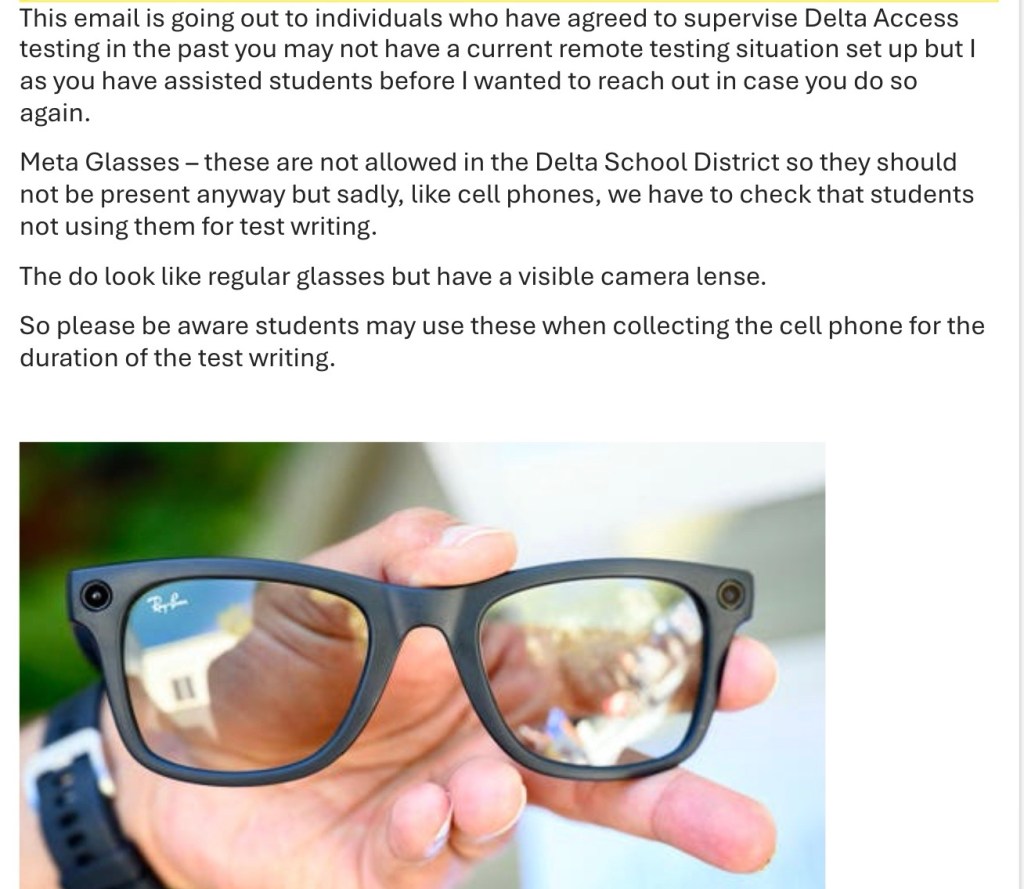
This email is going out to individuals who have agreed to supervise Delta Access testing in the past you may not have a current remote testing situation set up but I as you have assisted students before I wanted to reach out in case you do so again.
Meta Glasses – these are not allowed in the Delta School District so they should not be present anyway but sadly, like cell phones, we have to check that students not using them for test writing.
The do look like regular glasses but have a visible camera lense.
So please be aware students may use these when collecting the cell phone for the duration of the test writing.
Here’s my updated short video re stealth technology:
Okay – glasses are an interesting exploration… the good – augmented vision to help those of us with maladies see things with greater clarity… the bad – what happens when (not if) glasses do so much more than just help correct vision:
A) audio support – for a long while there have been options with speakers taking advantage of either being close to the ear (cheap version that can be overheard easily) or making use of bone conductivity (and not as easy for interlopers to overhear). I know many still have problems with students who have sensory issues and use headphones in particular to either drown out the busy world or use a different noise as a ‘white noise’ – I’m an example where my tinnitus often makes it better for my brain to have extra music/podcasts/?? on the go to help my brain focus… but traditional white noise (oceans, campfires, etc) are not to my advantage. But silence is by far the worst – not much ‘louder’ for me than a quiet workspace…
B) augmented surveilance – this is the emerging area where people like to look at the low-entry points: cameras. And yes, this is an emerging issue – especially in the world of education with a simple example that has been shared… educator goes to do a washroom check with meta glasses… are they recording? Whereas might it be good as a ‘body camera’ to allow a review of ‘what was seen’ by somebody? Where does the good/bad line get drawn?
C) enhanced cognition – the cameras plus speakers plus AI give another level altogether of tech collaboration – the tool identifies who is around you and can prompt you with names (good for me) and where you may know them from (linkedin?) and even give you quick feedback prompts (fact checking) based on what the input of speakers also hears. And the current display setup lets the one person see data but the person gazing into your eyes does not see the same…
So – what if this enhanced augmentation is helpful.. calming and helping focus neurologies stay focused? If we are worried about cheating, then we will be banning every tool of learning. Copying from books – pencils and pens writing down cheats – talking in code (coughing for a/b/c/d multiple choice prompts anyone? Just me…? Okay…) If every tool can be used to cheat, maybe the problem isn’t the problem..
Here’s my takeaway (probably heightened with Ontarios regression to final exam emphasis returning to the headlines) – is the issue about being worried about “using them for test writing”? The why don’t we pivot and better enhance what the neurological experience can be? It is a good time to reflect and review what we mean by an “open book” exam anyways… but also could be a great opportunity to explore why students are using AI when they are. Reminded by a re-watch of a Sir Ken Robinson video – in school it’s “cheating”, everywhere else it’s “collaboration” (or ‘research’ as per Sugata Mitra).
Funny how tools are ‘support’ … until they work too well..
 Technolandy
Leave a comment