Day 162 (of 2025/26) Our School-Based Comic Con: Too-Early Reflections
Now is probably not the time to ask what I thought.
A few days ago, when I drafted this title, I assumed I would be stuck reflecting on everything that did not go according to plan. That is often the way with events like this. The brain tends to replay the glitches louder than the successes.
But honestly? There were only minor bumps. A few language reminders, a couple of push-kick-tease combinations that needed redirecting… all completely expected in an open-ended event where excitement runs high.
Our Comic Con is intentionally built in the spirit of an EdCamp. I tell students and parents from the start that I expect them to get up, move around, and leave sessions to explore other spaces. That is not disengagement. That is engagement.
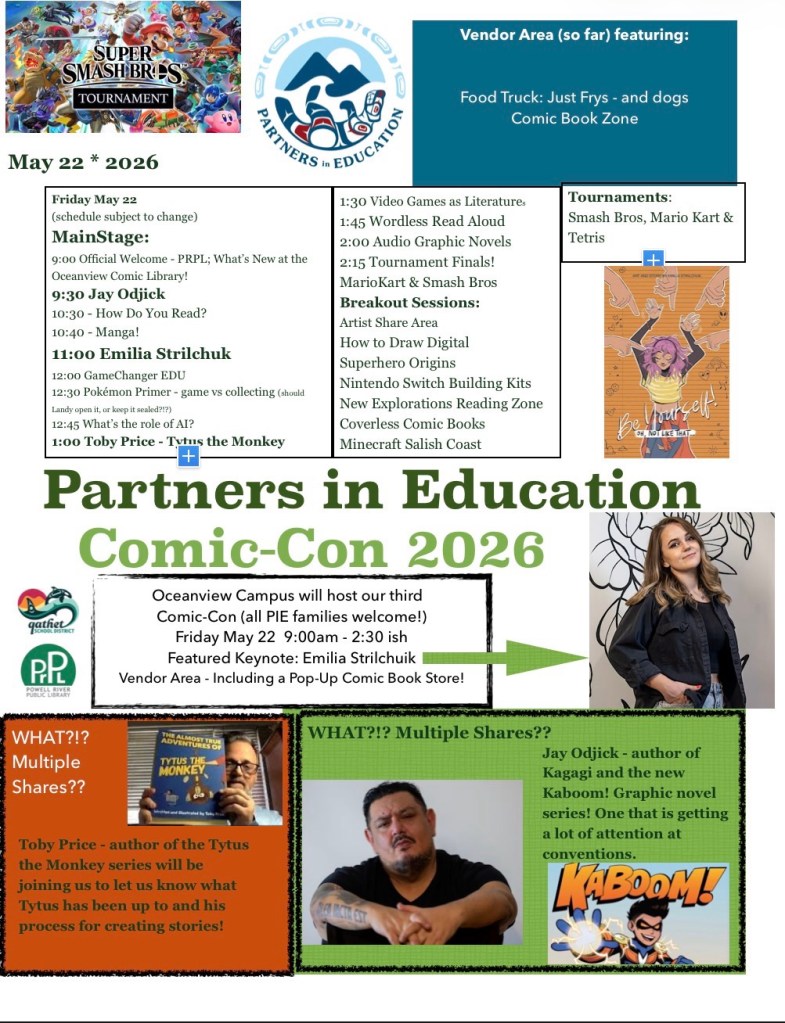
We had our drawing room for sketching and reading, our courtyard for conversations and quieter comic exploration, and our commons area where the “main stage” always had something happening.
And my keynotes have always been awesome and inspiring. I have loved that Toby Price has continued popping in each year after ‘leveraging’ our online friendship into him being or first Comic Con Keynote. Last year we had two (Tony Weaver Jr’s amazing Werido!) and this year we had both indie darling Emilia Strilchuk and new Scholastic Book Fair star Jay Odjick (two books with Robert Munsch and now Kaboom! – the first in a superhero trilogy). This allowed me to have content shared for our secondary, middle years, and primary students. Now the pressure is on for next year….
The structure is deliberate: enough organization to create momentum, enough flexibility to allow curiosity to take over.
The main stage is our anchor. This year I leaned more heavily into recordings, which was a good call. I have learned that I do not need to be “on” every minute for the day to work. This is where our keynote presentations Teamed in, where our exploration shares happened, where our ALA (Ask Landy Anything) panels unfolded, and where our esports finals wrapped up the energy of the day.
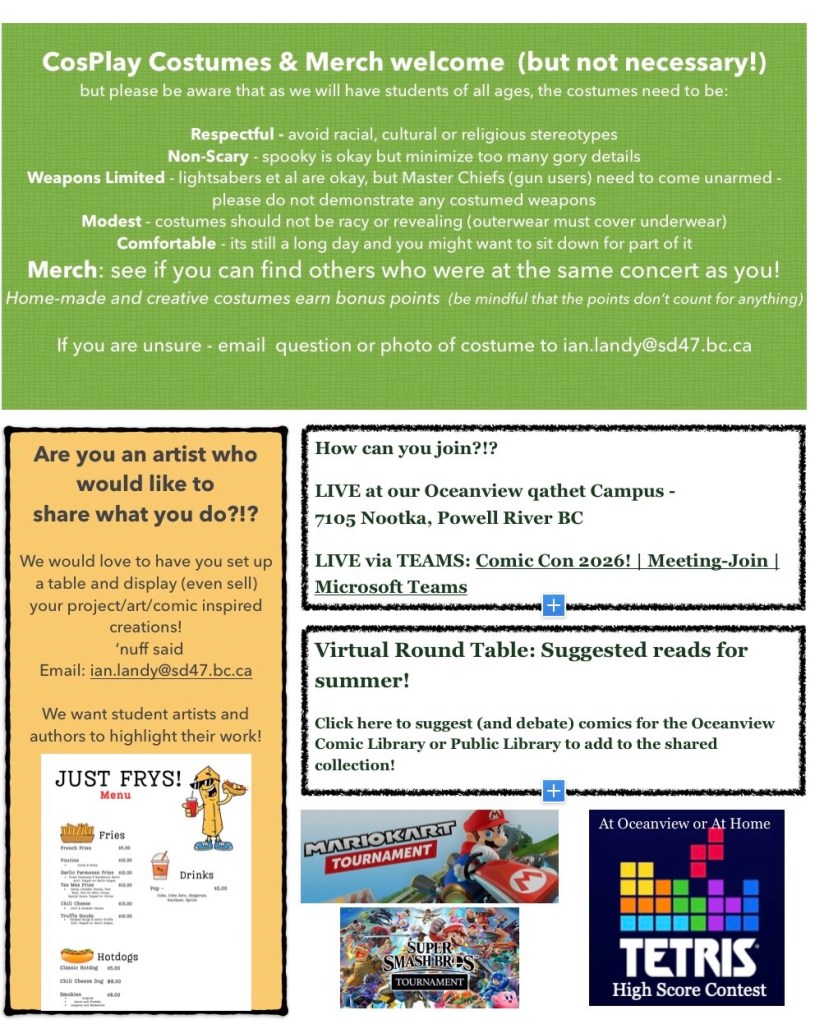
My office, once a sewing and computer lab and now roughly three-quarters of a classroom, became our esports arena. This year it hosted Mario Kart, Smash Bros., and two retro Atari-themed systems so students could sample some original gaming history.
I used to keep Tetris in that room too, but this year it moved into the wings of our commons area, right across from our pop-up comic book store.
Our primary room opened into a workspace that became the drawing room. We stocked it with comic templates, sketchbooks, sharpened pencils, an iPad, and encouragement to explore what may be the most underrated creative app available: Notes. There was also a box of comics there for free exploration.
The commons area also opened to our courtyard. Access to other levels was closed, but the courtyard offered fresh air and another place to read, reflect, and explore first issues and origin stories. Nearby, our Study Hall remained open for anyone who wanted to check in on coursework.
And of course, on the main floor were the giveaways.
Prizes for stamina. Prizes for costumes. New additions to our comic book library.
One standout addition was the graphic novel adaptation of Lord of the Flies. For a first encounter with the story, it is dramatically more accessible than the original novel, whose British private-school colloquialisms can make Shakespeare feel like contemporary speech. It is a stunning adaptation, and I suspect it will become a first-offer text for some of our senior English Language Arts students exploring that story.
We also added a new section of wordless graphic novels. These were beautifully curated through recommendations from librarians who understand the power of visual storytelling to transcend language barriers while still addressing the Big Ideas of our English curriculum.
After all, nowhere in the curriculum does it say students must read a particular text at a particular age. It asks them to think, interpret, connect, and create meaning.
I love the support I have from staff.
I always jokingly frame it as “landys vanity project” in the in/formal sense because I want this to remain something that can run without requiring everyone to monitor rooms or host sessions. It is my vanity project, as I tease it.
And yet the support is everywhere: subtle encouragements, quiet check-ins, and the shared belief that this matters.
I am still stunned when I see Comic Con attendance listed in student notes, IEPs, and SLP goals as something learners are working toward throughout the year.
That says everything.
My biggest hope moving forward is to create even more opportunities for students to share, sell, or give away their own creations.
But as with everything at our school, this is always a “get to,” never a “have to.”
That distinction matters.
It is why I am rarely worried about problems at Comic Con. The students who attend want to be there. They choose to be there. And because of that, they help create the atmosphere themselves.
I am still reflecting on pacing. I am thinking about the need for intentional breaks throughout the day, informed by my own experiences at comic conventions and festivals where stepping away is part of what makes the return meaningful.
But even in these too-early reflections, one thing is clear:
This was a success.
As one staff member shared:
“What a success! I saw more students engaged, having fun, and socializing at OV than I ever have. Very cool idea, Ian. Thank you for all the work and passion you show. PIE staff and students are so lucky to have you as their leader.”
For a K–12 provincial online learning school, where students are rarely all together and often drop in rather than stay all day, that kind of feedback says more than any attendance count ever could.
Comic Con continues to become exactly what I hoped it might be:
A space where students can belong through the things they love.
 Technolandy
Leave a comment