Day 8 (of 2026/27) another reason to add video games as a unit in language arts! #tEChursday
It’s been long shared that playing Tetris after a traumatic incident can help the brain recover. https://www.nature.com/articles/s41562-024-01956-y
Now more looks are showing that while screens may indeed be part of changing brains…
That is not exclusively negative.
Nor is it automatically educational…
Pilots and surgeons have seen gains when video games are part of their training…https://www.nature.com/articles/s44271-026-00470-3 and https://pubmed.ncbi.nlm.nih.gov/33419578/?utm_source=chatgpt.com
But Mario may be helpful for brains…
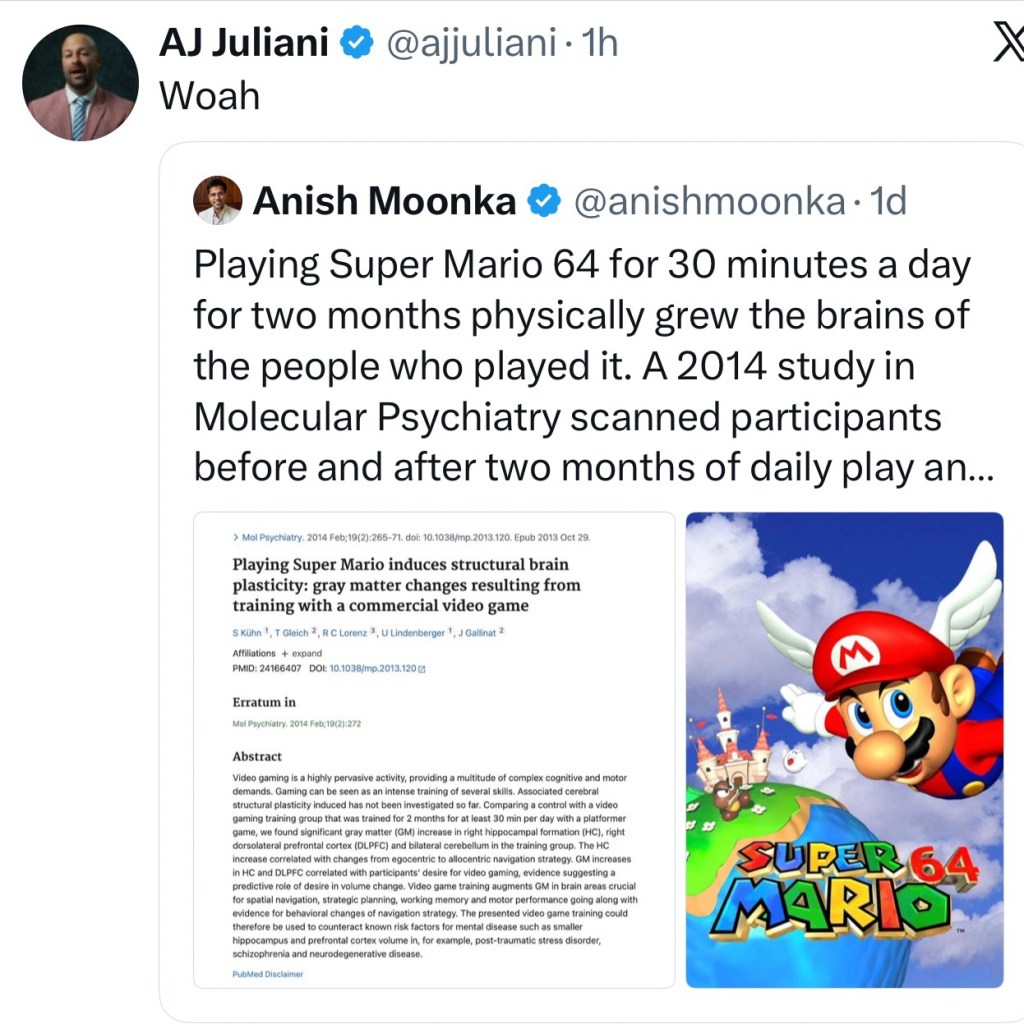
As I also read online from Ken Williams (@unfoldthesoul): Video games, love them or hate them, provide raw and instant feedback. They don’t dumb down depending who is playing. The standard is set and the player rises to achieve it. Sounds like something schools should think about.
Me: Many good things about video games. Tetris vs trauma, Mario 64 build brain… there’s no averaging of how many times till you got to the right castle…
do,
learn,
fail,
learn,
collaborate,
watch,
question
practice,
then level up.
The game doesn’t say, “You’ve already had three attempts, so I’m averaging your first, second and third castle attempts into a 63%.”
Admittedly – design of game matters. I anticipate that November 19th will be a high absence date because of the release of Grand Theft Auto 6… likely bigger than the usual Madden players who miss work on that annual release (in the summer)…
But also… it’s shifting the narrative that Gamers are ‘just’ good at games.
toward:
“Some skills developed through gaming may interact with learning in a real-world high-stakes domain.”
And even building cognitive load and working memory may benefit from the right video games https://pubmed.ncbi.nlm.nih.gov/42184801/?utm_source=chatgpt.com
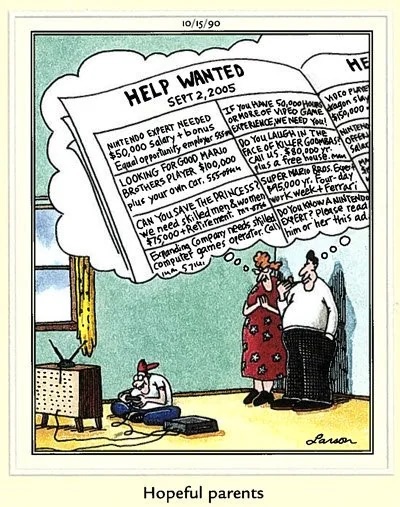
Once referred to simulate by Gary Larson…
And critically:
A 2026 systematic review of digital game-based language learning found that immediate corrective and multimodal feedback were the most common feedback mechanisms studied, with reported improvements in vocabulary, grammar, engagement and motivation. The authors also identified a major gap: relatively little research on listening and reading. https://rsisinternational.org/journals/ijriss/view/feedback-mechanisms-in-digital-gamebased-language-learning-a-prismabased-systematic-review
There’s another meta-analysis in nursing education where immediate feedback in serious games produced a large effect on skills compared with traditional learning approaches. https://pubmed.ncbi.nlm.nih.gov/40120163/?utm_source=chatgpt.com
There is no averaging how many times it took you to get to the castle.
You do.
You learn.
You fail.
You get feedback.
You watch someone else.
You collaborate.
You practice.
You try again.
Then you level up.
That’s another reason video games deserve a place in Language Arts.
The game doesn’t lower the standard because you’re struggling. It changes the information you get while you’re learning how to meet it.
Ready Player One? Or collaborating with Player Two??
 Technolandy
Leave a comment