Day 14 (of 2026/27) Fridays are for: Option 3: Learning (Pro-D Day)
First off, I loved how our professional development day framed around BC Professional Standard 9 was rolled out earlier this week that we would all be bussed to where the day of learning was going to happen… brought up a lot of anxiety and worries (I am not a good bus rider… so I prepped my AirPods and sunglasses accordingly – yes, I used to also model this when I took my classes on field trips… and yes, I used to have a portfolio of transportation… I had genuine empathy for those learners who had a loooooong ride twice a day… looked into getting satellite wifi for the busses)
.
I loved it because of the association of busses (and flatbeds and other vehicular pickups) taking indigenous youth away from families and to a place where they could not easily leave (no air conditioning either… and sharp opinions between whether windows should be open or closed)… a horrible part of residential school era that is often overlooked…
.
So the aspect of leaving our places of comfort (even that – relative comfort as secondary schools have their own problematic parts for learners and familial memories) and take to a place with less/no familiarity and no easy escape home (well – a cell call away…)
*****start of day*****
Maybe the script on the bus could’ve been a bit more pointed. Still good to share the connection the school bus has had with Residential School.
*******
A young elder joined with a great shares including one about Cousins House as an asset – how it takes a village to raise a community.
*******
Neat share that many of the holder houses were shipped up from Ladner (and the reminder of not being home owners under “The I Act”)
*******
Neat references to archeological records lining up with the Younger Dryas era (10 000 years ago)
********
Great share on how the Nation is working on complex care, transitional housings, and “getting old” housing (names of projects have much nicer names in ayajuthem…
*******
In the longhouse we were welcomed with a mask dance…! Respectfully leaving the images to the memories of those of us who were in attendance.
*******
And a “Raven Tale” – definitely a favourite story character! Again, oral story tradition so not going to make the mistake other mythologies have had and write it in alphabet form.
*******
Great video modelling how learning is happening with (and from) the children. Traditions. Respect (elders, nature, what’s provided…)
*******
Panel of learners (older learners – the grade 3s got nervous when thinking about speaking in front of a couple hundred education staff!!)
*******
Really hope that the recent growth of Tla’amin gets shared around the province – pretty good examples of what a Nation can do… shares from some great (future) ancestors…
*******
Powerful share around “quiet” and having low voices as a legacy from residential schools. The way that was “taught…” continues as a legacy, one that hopefully can be changed to more demonstrations of vibrant respect.
*******
Reflections on having Tla’amin be seen and valued in schools:
shy as a kid, had to let that out;
value of kind teachers;
relationships;
connection to/through sports;
cross cultural experiences;
class coming to “my” home!;
Tla’amin fishery visits;
collaborative pro-d days;
seeing changes in schools (and education curriculum);
changes in I act interpretation – example provided of when non-natives not allowed on reserve land
(I still show appreciate one of my favourite people, Dr Brad Baker, taking out his wallet when presenting to principals and showing his status card to show he has it on him so that he ought not be arrested…)
the long story that it took Tla’amin to reach nationhood. 🧡
okay to have opinions and debates, not so much on historical facts –
reciprocity truth and reconciliation need patience and supports.
hard topics are there and definitely cause discomfort.
education department supporting in a variety of ways to build future leaders
.
oh – good reminder of the frequency of foster parents being an area of growth with/after residential schools
and the exclusion from post-secondary
and not valuing that there was ayajuthem language in schools (and not common in all communities in the province – I remember the fight in my first year as a teacher for a grade 7 st’at’lium language immersion program for Friday afternoons in my hometown… )
power of learning basic building blocks of language to learning (not in its own silo)
.
safe places. before, during, and after school.
support and (for) attendance
assessments for better identification for appropriate results (not just centralized in big cities)
feel there is now a strong foundation for youth
.
vitalness of connections
moments of symbolism and solidarity
.
orange shirts matter

giving kids opportunities.
.
learning through the system – different now, than “then”…
Suggested pathways for us in attendance
- more of why we are here today (reflect on what we are doing)
- know it’s important than when invited… come. it’s special.
- when it comes to difficult conversations, don’t feel guilty for negative thoughts and emotions – reflection brings out good and bad reactions reflect on what happened not about (more) shame. be easy on self and others, hard on the topics. Lift each other up
- educate ourselves by learning from (and with) one another.
- if you don’t understand, ask – it’s how we find things out.
.
*******
Herring to Huckleberries
.
I am looking forward to this one as an influence to an evolution of History of Math 11 to a First Peoples HoM 11 – indigenizing math similar to our EFP (English first peoples)
.
Can’t apply western math to local context.
Start with the culture
The basket weaving
The fish traps
.
The order may not fit some bias of math (there is no order in how to unpack math…)
.
I do ponder what may change as “we” archive more oral traditions to “in-print” editions.
.
Herring To Huckleberries
Indigenizing math
Start with story
.
Research supports using high quality picture books
Enhances the learning of math
Than any worksheet
.
Spatial reasoning
Ways of thinking that are fundamentally mathematical – not just ‘saying it’
Spatial reasoning skills are research supported to being better at the maths
.
Beach scene: Circles expanding (as per fish jumping) bloom – with one at the center… as in ‘concentric circles’…
.
Thus draw the water when a fish jumps
.
Math as embedded into a story… and how language embeds numbers … and reflects how thinkings are thought…
.
(The example I like to give – there is a word for five, a word for salmon, and yet another word for ‘five salmon’ – not just a boring blending of the two like we tend to do in English…)
.
Examples from the book…
******
Branches – how the tree in the background is ‘branching apart’ – similar to how we break apart numbers into smaller parts. AKA Fractals
Thus activity – build a fractal tree
Extension – how communities in many cultures are built and designed that way – a great house surrounded by smaller and smaller ones… as opposed to the rows and columns of other civilizations.
*****
Drying racks for the fish – with instructions on how to build the racks… start with one – another ‘the same’ as the other parallel – but break apart what the words are and what the arrangement is – ‘same distance apart… how do the other sticks with fish on them get arranged… like a cross/plus side – “like train tracks” if railroads are in the kids schema… maybe even 90 degree angle? Aka perpendicular.
Learning the terms not as ‘terms’ but in authentic use. Parallel may mean ‘along side’, perpendicular may mean train tracks to some, crosses to others….
*******
Close your eyes and imagine you are the eagle in the sky… what could you see? Perspective… radius… what do you see specifically – three circles on a stick? (3 rowers on a canoe) – concentric circles from the paddles?
*******
What do you see when you are lying on the ground – how does that change your perspective…? How many stars are in the sky? How might you estimate a guess? Do all the starts appear the same?
.
Rabbit hole – sizes of beds… what are the differences between the sizes of mattresses you may want to own to sleep on?
.
Special reasoning difference
- being able to imagine a pen
- Imagine the pen in motion
- Working through the relational components…
- Relationship and in movement…
.
Though I’m curious what happens for neurologies that are unable to visualize words as the objects they represent…
*******
Salmon spawning – how do you tackle estimations – how many fish are in the river… chunking? Approximately? The ones you don’t see? Season via the colours of the plants… the clothing
*******
Mathematical invitations to each page… different throughout: drawing, noticing, gesturing, enacting, expressing…
Don’t have to do the math things via each page…
*******
Fabulous parting story about being told by an elder (granny) to go to school to learn how to read and write so I can tell what the white man is saying in these letters. I need you to do well in school to help me… she lied – she was a very strong reader ~ that was the same as my Baba – thought she didn’t read well (except for going through the National Enquirer) until quite late into her 80s where she started to read books faster than any of us thought she could…
.
Sidebar – spinning out of Simon Sinek’s Leaders Eat Last, with limited seating because of great participation today, I chose to model Leaders Sit Last and ensure my staff (and all teachers, education assistants and support staff) and district educators had a seat (and better view) than I did! May be a book in there…
.
Sidebar 2: I wonder if anyone is going to chat with me about being on my phone during the day. I process best when taking notes and pen and paper (provided) leads me to thoughts of frustration. Text and typing is better for my legibility and the keystrokes for me are what others find helpful by using cursive… it’s how I slow down my brain to stay focused. It’s not 1988!!
.
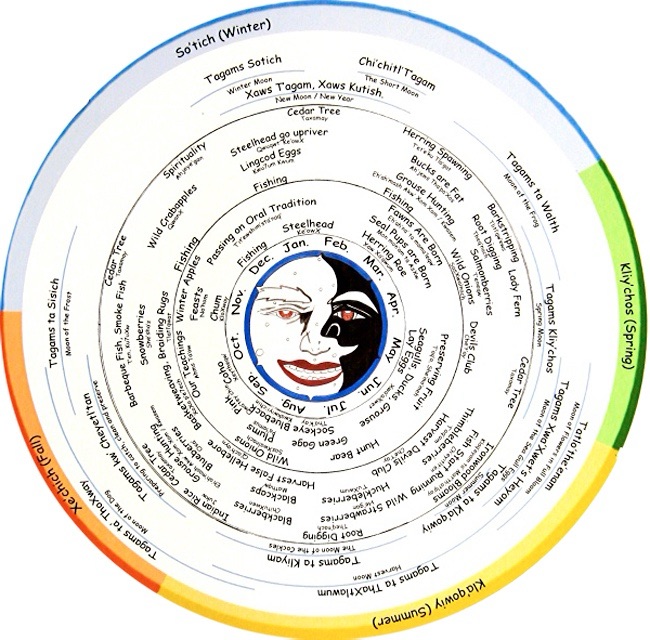
And an homage to the 13 Moons calendar of the Tla’amin


Leave a comment