Day 33 (of 2026/27) Reflecting on the first provincial pro-d day that was chosen for me… (topic admittedly by me as part of our district pvp group) Challenging Conversations 2026
.
Fridays PSA (Provincal Pro-D Day) was the first time in my career (I think) that I did not attend a PSA (provincial specialty association) day and instead was told we were doing a justice institute session on difficult conversations… definitely some tough internal conversations around that… but having attended this session a couple times previously, at least I knew I would be getting some good thinking and reflecting to happen… Some takeaways from the day:
What Can We Do?
Above the line thinking (be self-aware/challenge your thinking etc. = constructive behaviours
Below the line thinking (blame, judge others = unconstructive behaviours
Video: Locating Yourself – a key to conscious Leadership: the conscious leadership group Locating Yourself – A Key to Conscious LeadershipYouTube · The Conscious Leadership Group2.4M+ views · 11 years ago
Unconstruvive: They’re wrong; it’s not my fault; it’s go to be my way; I don’t trust what they’re saying
What can we do that’s construe? Above the line:
- What are my responsibilities here?
- How can I accept what’s happening without blaming someone else?
- Where can I take ownership and accountability?
- How did I contribute tot his?
- What could I be doing differently?
- What is my role in this situation?
- How can I make a difference?
- How can I be helpful and of service to someone else?
- How can I cooperate?
- How can I support?
- How can I add value?
- How can I involve the right people?
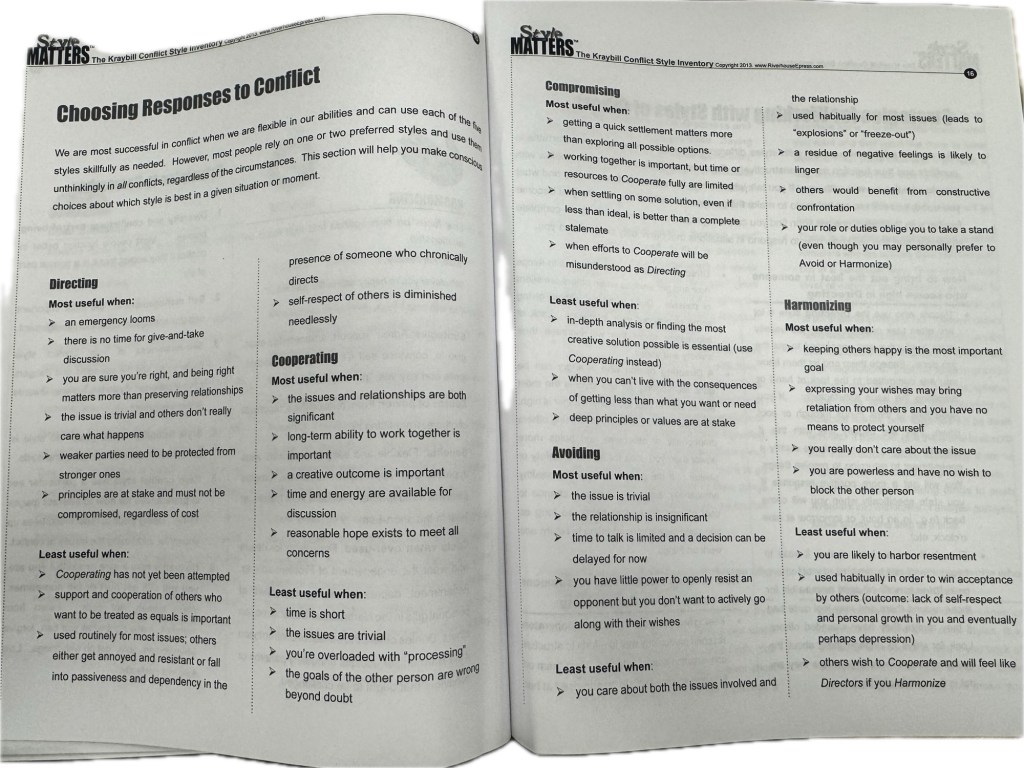
Conflict Styles
Competing – power driven approach, often sued when quick decisions are needed or when standing firm on critical issues. Best used in high stakes situations but can damage relationships if overused
Collaborating – a win-win approach that seeks mutually beneficial solutions. Ideal for complex conflicts where both parties needs matter, but requires time and effort
Compromising – a middle-ground approach where both parties give up something to reach an agreement. Useful when time is limited but may lead to solutions that don’t fully satisfy either party
Avoiding – not engaging in the conflict, either by withdrawing or delaying the discussion. Useful when an issue is minor or when emotions need to cool down, but can lead to unresolved problems,
Accommodating – prioritizing the other party’s needs over ones own. Effective for maintaining relationships, but can lead to resentment if used excessively.
.
Nice discussion on ‘when’ each of the styles can work… what the pros and cons are…
And differences between ‘one-offs’ and ‘predicative style’…
And speed…
And the nature of our jobs as Principals/Vice Principals
Role of: Relationships
Histories
Trust
Risk-Taking environments
And value of the topic…
.
How we act when ‘calm’ setting (differences exist and feelings are not yet high)
How we act/react when in a ‘stormy’ setting (differences persist and feelings escalate)
.
And a great reminder that all of these styles are on a continuum – we all noted that we will make use of all styles, but need to be aware of how we are seen – and how we present…
.
Love a share around ‘compromise’: my kids liked mild cheese… Liked aged cheddar… we compromised with medium and no one ate it
*Todd L Rose End of Average – aim for average and miss everyone!
.
Reminder of locus of control
.
Ponder: Given my style, and its drawbacks, what do I need to do to be more effective at navigating challenging conversations?
Is it worth spending some time with some below the line thinking… ? Knowing that everyone is doing the best they can… but I am coming in to most situations ‘above the line’ … is there value in spending some time below?
This links to an idea I had earlier… “principaling angry” – based on the movie F1 – not ‘being’ angry, but having a ‘set mindset’ that mindfully may not be what ‘others wish for’… and also a tad out of the norm… mad at the situation(s) NOT the people…
.
Do we need to pivot (know ‘when’) from our style to do something different…
.
How often do we prepare for being in ‘a storm stage’
.
.
.
Ladder of Accountability
Fix the Problem Accountable Behaviour
Find/Create Solutions Responsible
Own the problem Powerful
Acknowledge Reality ***** this is what is needed to keep climbing towards a solution
Wait and hope Abdicating Behaviour
Make excuses Victim
Blame others Powerless
Unconscious/unaware
.
.
Collaborative Conflict Resolution Model
- Preparation
- Setting a collaborative tone
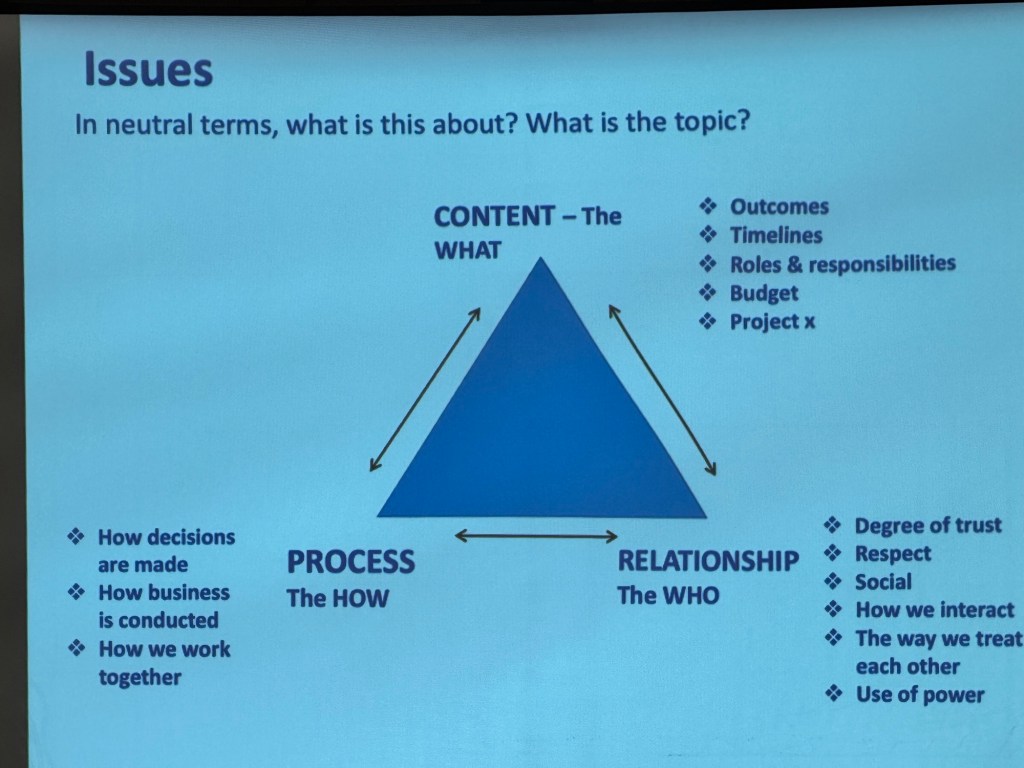
- Identifying issues/topics
- Exploring interest/needs/assumptions / intention / effect
- Agreement or next steps
- Reflection.
.
.
Considerations
Phase 1
- When and where to meet
- Who needs to be involved
- What is the problem? Can it be described neutrally
- What impact or consequence will the behaviour/situation have if it continues
- What information do I need? Are there specific examples that can be referred to?
Phase 2
- Set the collaborative tone
- Clarify the intention for the discussion (alignment)
- Acknowledge their experiences/intention/needs
- Engage them in dialogue and resolve issue
Phase 3
- Identifying tissues/topics
- Content-process-relationship
- What is the problem
Phase 4
- Exploring interests and assumptions
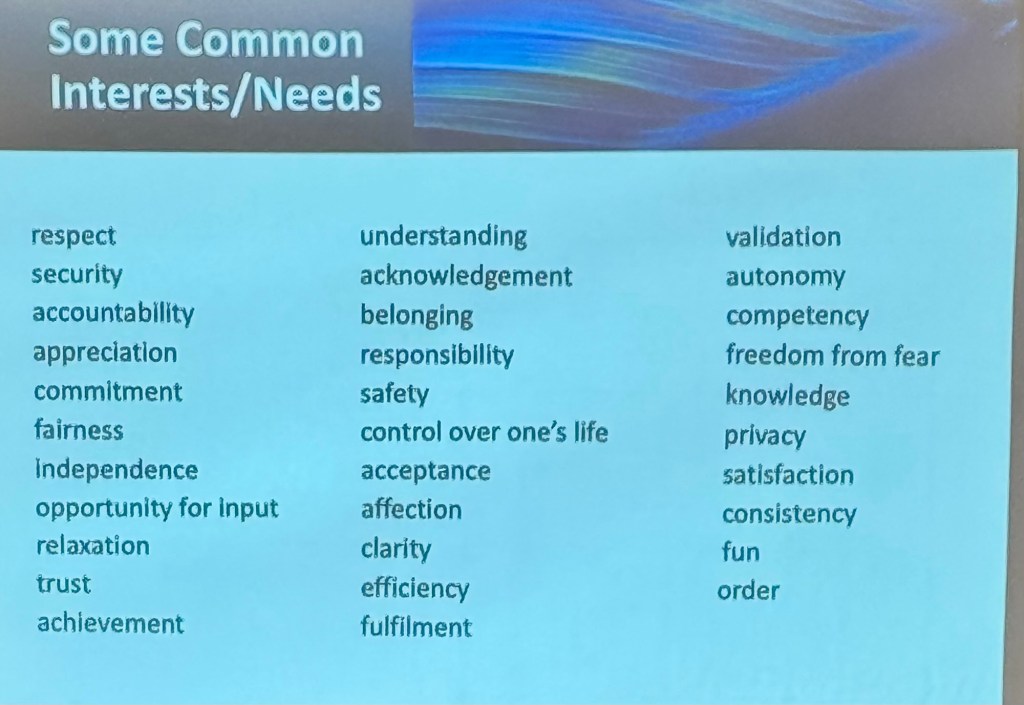
- My interest/needs
- Common Interests/needs*
- Their interests/needs **
- Assumptions being made (both) – gotta be careful…
- What is important?
- Clarify assumptions
- Get input from others affected by the problem…
Phase 5
- Reaching agreement/determining next stops
- Possible solutions
- Whose needs are met
- Next steps
- When
- How
- Who does what
Phase 6
- Reflection and followup
- What worked well (for me)
- What didn’t work well
- What could I have done differently
- What am I taking away from this experience?
.
.
Intent —> Private —> Known to one, unknown to the other (we assume the other understand our intent and the effect is consistent with that intent)
Action —> Public —> seen and heard by all; a fact
Effect —> Private —> Known to one, unknown to other (We assume the other knows the effect of their action on us and that they intended this effect)
.
Assumptions – always good to be mindful of them… Cement Mixer – Jealousy – El Celoso
.
.
Three Levels of Listening
.
Top: Focus is on other person. Listening with your eyes & ears
Middle: Start with listening to other person. Focus shifts to your own experience/story
Lower level: Easily distracted. Little focus on conversation
.
.
Open Ended Questions
- Elicit information: what, how, when, where, who, How Come (not why?) or What’s the reason that…
Closed questions
- Confirm information: Did I get that right? Did I miss anything? Yes/No…
.
“I” language
.
Descriptive and assertive language When you didn’t call back, I was disappointed (as opposed to ’that’s disrespectful)
.
Defensiveness “Is a reaction to an uncomfortable feeling. Defensiveness is an unconscious effort to protect the self from anxiety. It boils down to a choice between pushing back, feeling angry… “
.
Stress/Anger arousal cycle = the impact of quality of judgement… ‘go for a walk together’ – consider trauma response to get calm and increase the quality of judgement and reduce the highly reactive fight/flight … high emotions are not the time to make big/significant decision
Managing reactions
- Recognize emotion is information
- Be present. Give them your full attention
- Acknowledge the interest/need they are expressing
- Use empathy/acknowledgment/validation
- Be curious and ask question to understand their perspective
- Paraphrase their perspective
- Stay focused – resist getting side tracked
- Use silence to allow thinking time (and use wait time)
- Clarify your intentions
- Focus on the problem, not the person
- Do NOT try to fix the problem by giving solutions/suggestions too early
*Common interest/Needs
** Explore open ended question to uncover:
- Concerns
- Hopes
- Expectations
- Assumptions
- Priorities
- Beliefs
- Fears
- Values
..
.
Glad that the pro-d chosen for us led me to have some good takeways from the day!


Leave a Reply